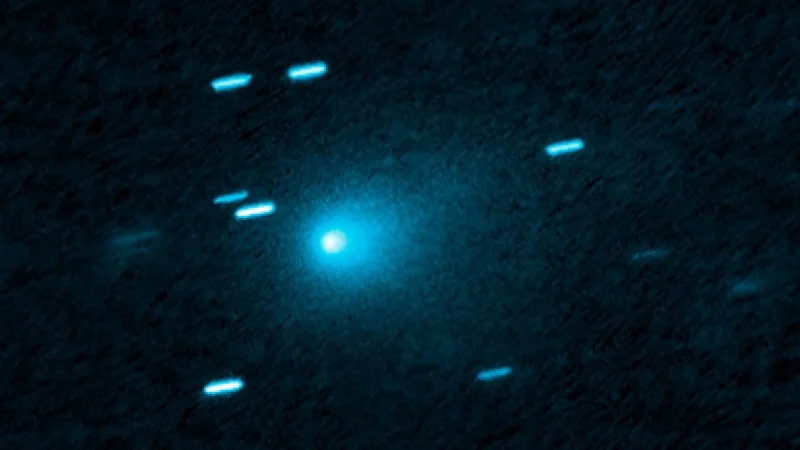
Researchers using the James Webb Space Telescope have found that methane escaping from interstellar comet 3I/ATLAS carries a deuterium-to-hydrogen ratio 13 times higher than comet 67P/Churyumov-Gerasimenko. The measurement, reported in Nature Astronomy, gives astronomers a rare chemical clue from a visitor that came from beyond the Solar System.
The observation was made in late December 2025, when 3I/ATLAS was about 2.5 times as far from the Sun as Earth is and was moving through the asteroid belt between Mars and Jupiter. In the new study, researchers analyzed the chemical cocktail emanating from the comet’s atmosphere and focused on methane because isotopes can act like fingerprints of the conditions that shaped a body long before it entered the inner Solar System.

That comparison matters because 67P/Churyumov-Gerasimenko is the only other local comet with a secure deuterium-to-hydrogen signature, and that required in-situ measurements from Rosetta. By contrast, the methane in 3I/ATLAS showed significantly more deuterium than any body in the Solar System, pointing to ices that likely formed in a cold, low-metallicity interstellar or protostellar environment under a high cosmic ray irradiation rate.
The chemistry also leaves room for more than one origin story. One possible home is within the pancake-shaped planet-forming disk of dust and gas around a very young or forming star, but the study also says 3I/ATLAS may have formed more than 7 billion years before the Sun ignited into life, may have been exposed to lots of radiation, and may have been born in a prestellar core. That is the friction in the finding: the new data are unusually specific about the ice chemistry, but they do not pin down exactly where the comet was assembled.
For now, the best reading is that 3I/ATLAS is carrying ancient material that preserves conditions from a very different environment than the one that formed the Solar System. The new result does not close the case on its birthplace. It sharpens the mystery, and it makes the next comparison with another interstellar visitor or future observation of 3I/ATLAS the detail astronomers will want most.