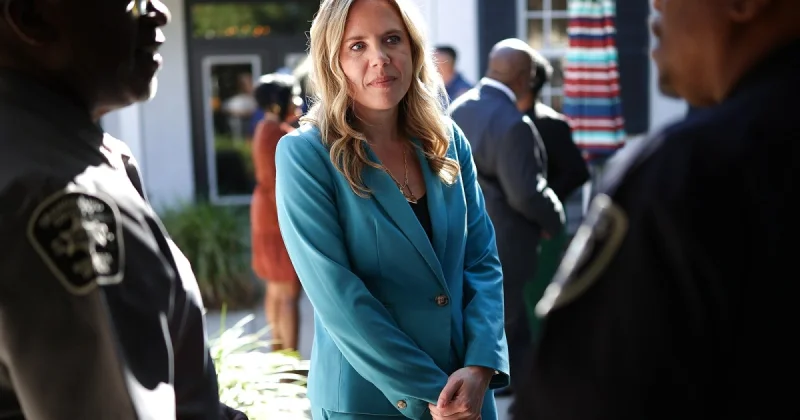
Dr. Annie Andrews and Republican Sen. Darline Graham are tied at 48% each in a new New York Times/Siena poll released Wednesday, with 3% of voters still undecided just days before Election Day. In South Carolina, where no Democrat has won a Senate seat since 1998, the result puts Andrews within striking distance in a race that would have been easy to dismiss months ago.
That alone is enough to explain why her name is drawing attention now. Andrews is a pediatrician who has never held public office, yet the poll shows her winning 97% of Democrats, 59% of independents and 22% of Republicans — the kind of cross-party support that would be hard to ignore in a state long tilted toward the Republican Party.

The question is how she got there. Andrews has spent the race trying to separate herself from the national Democratic brand, saying, “Democrats have failed on the border,” and, “I don’t support Medicare for All.” She has also said she was “raised in a Republican household,” and she did not name a national Democrat she would want campaigning with her. At a debate this month, she pushed back after Graham called her a “socialist” and tried to label her “Bernie Ocasio Mamdani,” telling voters she backs no taxes on tips and Social Security, and calling some of Donald Trump’s attacks on her “not presidential” while also blasting his tariffs as “unconstitutional.”
That balancing act is the friction in the race. Andrews is running as a centrist while criticizing her own party on some issues and attacking Trump on others, a posture that appears aimed at voters who are unhappy with both sides but still not certain they want to break with their party. One of those voters is Ryan Manuelsmith, a 29-year-old substitute teacher from Columbia who said he plans to vote for Andrews and that it will be the first time he has voted for a Democrat; he described himself as “disillusioned” with the Republican Party.
If Andrews can hold together that mix of Democrats, independents and Republicans, she has a path to make the state’s old Senate pattern look breakable. If she cannot, the 48-48 tie will be remembered as the moment the race briefly looked different, not the moment it changed for good.