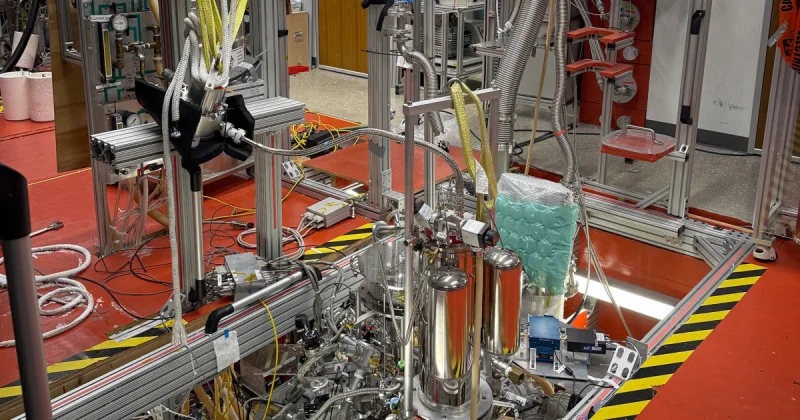
Northwestern University physicists have trapped a single positron in an exquisitely controlled quantum state for the first time, turning the antimatter counterpart of an electron into a system they can study one particle at a time. The team cooled the fast-moving particle to nearly absolute zero, suspended it in a near-perfect vacuum and built what it calls a one-positron quantum cyclotron.
The work matters now because it gives researchers a new way to search for tiny differences between matter and antimatter with a level of control that has not been available before. The study, published in Physical Review Letters, could sharpen tests of whether the rules that describe the universe hold equally for a positron and an electron, or whether the mismatch points to something deeper.
Thomas Myers, the paper’s first author, and Gerald Gabrielse led the experiment after capturing the positron from radioactive decay. In this state, the particle behaves much like an artificial atom, with quantum energy levels scientists can precisely control and observe. That is the shift: instead of trying to wrangle many particles at once, the researchers isolated a single positron and made it respond like a system built for precision measurement.

Gabrielse has spent years pushing similar techniques in other systems. Before this study, he developed methods to isolate a single electron and measure its magnetic properties with extraordinary precision, and he also pioneered ways to slow, capture and cool antiprotons. That background helps explain why this result is being watched closely: it is a continuation of a long effort to force nature’s smallest building blocks to reveal whether the rules we think we know are complete.
The friction is in the theory itself. The Standard Model describes the fundamental particles and three of the four fundamental forces, and it has been confirmed again and again with extraordinary precision. But Gabrielse says it still cannot explain why the observable universe contains overwhelmingly more matter than antimatter. He argues that the Big Bang should have created equal amounts of both, and that if that were true, the two would have annihilated and left nothing. “We know the Standard Model has to be wrong somewhere — or at least incomplete,” he said, adding that physicists are “very precisely examining the most fundamental and simple systems to find where the theory breaks down.”
The next step is straightforward, even if the physics is not: use the one-positron quantum cyclotron to push the measurement of the positron’s magnetic properties to unprecedented precision. The paper does not yet give the outcome of that measurement, but it does establish the platform for it. For researchers chasing the origin of the matter-antimatter imbalance, that platform may matter as much as the first reading itself.