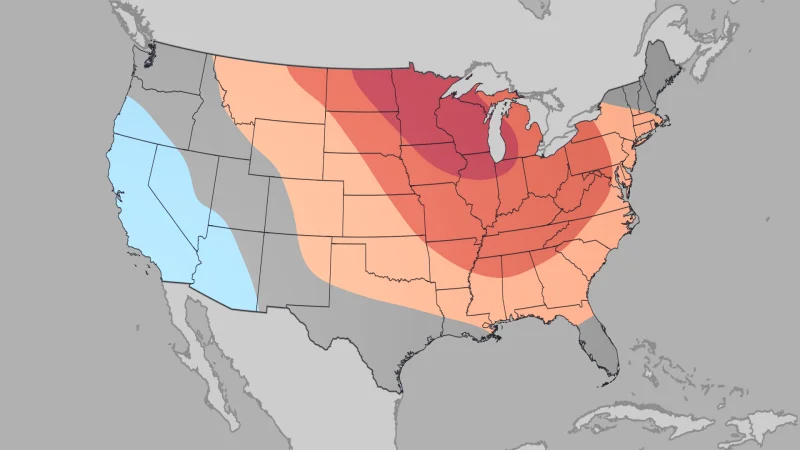
The Weather Company’s November outlook says El Niño will keep shaping weather across the Lower 48 this month, with the strongest signal pointing to above-average temperatures from the Dakotas to northern Indiana. That same pattern leaves the Pacific Northwest as the main area expected to run below average on precipitation.
For readers watching early November mountain snow risk, the bigger picture is a month that looks warmer than normal across a large share of the country. The darkest red area on the temperature map covers parts of the upper Midwest and Great Lakes, and above-average warmth spreads from the Northern Plains through most of the Mississippi and Ohio River valleys and into the interior Northeast.

The warm reach does not stop there. Slightly above-average temperatures are expected in the eastern Rockies and Four Corners region, most of the Southern Plains and Southeast, and the major cities along the Interstate 95 corridor. Average temperatures are forecast for New England, Florida, and the southern portions of Louisiana and Texas through the Rockies to the Pacific Northwest, while only California and portions of Oregon, Nevada, Arizona and Utah are expected to run below average.
Precipitation is less uniform, but the headline is that most of the Lower 48 should see average amounts. The only below-average area is the Pacific Northwest, while the soggiest stretch runs from the Gulf Coast of Texas to the Atlantic coast of Maryland. Slightly above-average precipitation extends from California and the southern portions of New Mexico and Arizona to a broad band from Texas to southern New Hampshire.
That mix is what makes the forecast tricky. The broad pattern is warmer and drier in the northern tier, drier in the Midwest and wetter across the South, yet the maps are averages and Mother Nature can still deliver local surprises. The outlook is also being framed as a record El Niño approaches, which is why the month ahead matters: it is not just about whether November turns mild, but whether the northern mountains get enough cold air to build snow while the South stays wetter than normal.