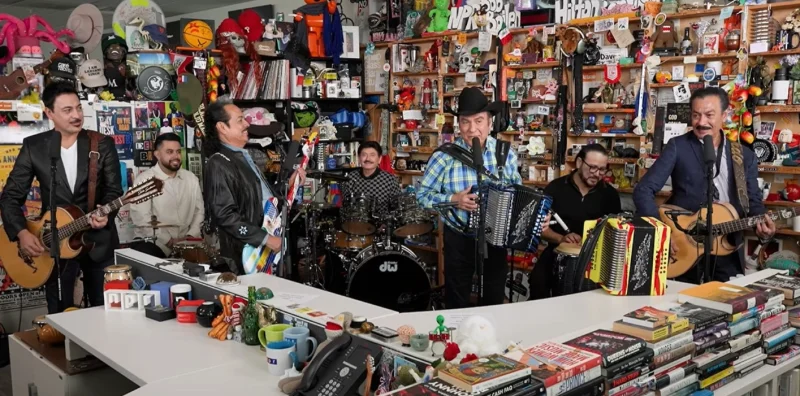
Los Tigres del Norte turned Thursday's Tiny Desk Concert into a direct message of support for migrants, using a more than 20-minute set in Washington D.C. to tie identity, love and belonging to a moment of pressure on migrant communities. Jorge Hernández stood with the group and delivered one of the night's sharpest lines: “yo soy la sangre del indio, soy latino, soy mestizo, somos de todos colores y de todos los oficios.”
The set mattered now because NPR rolled it out as part of its Mes de la Herencia Hispana programming in the United States, a stretch that began on September 15 and ended on Thursday. For the group, the timing gave songs about border crossings, family and self-definition a larger audience, and the numbers show the reach: Los Tigres del Norte have more than 2.3 million followers on Instagram, while the Tiny Desk post has drawn more than 200,000 likes on Instagram and nearly 150,000 on YouTube.

They opened with “Somos más americanos” from the album “Uniendo Fronteras,” then moved through “Golpes en el corazón,” “Quiero volar contigo,” “Ni parientes somos” and “La puerta negra.” Jorge Olegario also delivered a line that left little room for ambiguity: “aunque le duela al vecino somos más americanos que todos los gringos.” The performance was introduced by Félix Contreras, who told the audience their community was under attack and that the musicians had given people back their humanity.
That message landed against a harsher immigration climate in the United States after Donald Trump returned to the White House in January 2025. The article describes intensified deportations, family separation and tighter restrictions on migration pathways, and reported deportations rose to 443,000 in fiscal year 2025 from 271,000 in 2024. In that setting, a celebratory Tiny Desk appearance was also a public defense of people living under policy pressure.
Los Tigres del Norte are from Rosa Morada, in the municipality of Mocorito, Sinaloa, and the performance made that long immigrant-centered identity feel immediate again. What NPR gave them on Thursday was not just a stage in Washington D.C., but a way to make migration sound like memory, pride and resistance in the same breath.