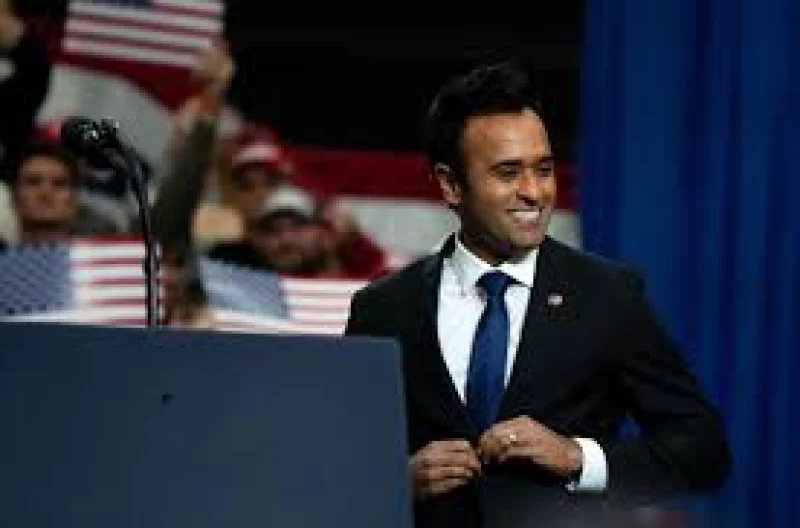
Vivek Ramaswamy’s awkward attempt to pick up a child on the stump in early October set off a wave of online mockery, but the reaction did not stop there. The next day, after he posted a picture of himself holding his son, many of the responses turned into ugly racist attacks that leaned on anti-Indian stereotypes.
The backlash is being read by some as more than internet cruelty. It is a snapshot of how Indians and Indian Americans are being pulled into a new lane of online conservative anger, with a visible minority group suddenly cast as an easy target after a viral clip gave critics a way in.
That is why the search around Ramaswamy has widened into a larger conversation about Indians in the United States. Zaid Jilani said people who already carried negative stereotypes about Indians saw the clip and decided, in effect, that Ramaswamy could not even perform the role of a normal American family man. He argued that the insult worked because it tapped into older assumptions: that Indian immigrants and Indian Americans are people who go to college, often hold advanced degrees, live in nice neighborhoods, make good money, and present themselves as family-values people.

Jilani’s point cuts both ways. The same traits that are often used to describe Indian immigrants as high-achieving and socially conservative-adjacent have not protected them from hostility on the right. He said Indian Americans and South Asians are highly visible compared with other successful minority groups, and pointed to Microsoft and Google as places where Indian Americans hold prominent positions, including the head of Microsoft’s Xbox division, who he said is an Indian American woman. Visibility, in this reading, does not soften the blow. It can sharpen it.
He also framed Indian Americans as a very small part of the country, estimating them at 1 percent to 2 percent of the United States. That makes the abuse easier to project and harder to diffuse: a micro minority can be turned into a symbol quickly, and a symbol can be used to stir anger even faster. The result is a backlash that says as much about the mood on the right as it does about Ramaswamy himself.
The contradiction is hard to miss. Indian Americans may overlap with Republican values around education, income, and family orientation, but they are still being hit with racist hostility from the same political space that might otherwise claim them as proof of cultural success. For now, the clip, the photo, and the abuse that followed leave one blunt conclusion: the line between admiration and resentment on the right is thinner than it looks, and Indians are increasingly the ones forced to stand on it.