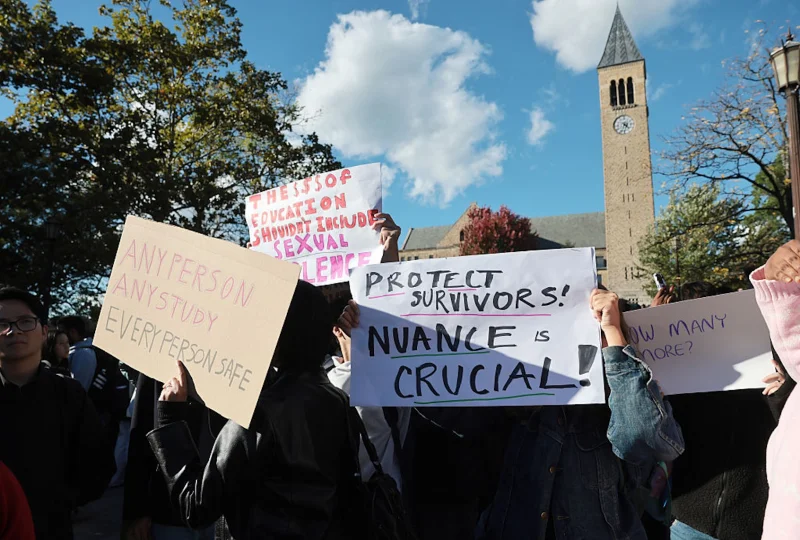
Thousands of students and faculty members marched on Michael Kotlikoff’s office at Cornell University on Monday, chanting for him to resign as anger over the school’s handling of rape allegations boiled over into open confrontation with the administration. Graffiti on the building the night before sharpened the message: “At Cornell, rapists are protected, protesters are expelled.”
The march came as Cornell’s faculty senate prepared a vote of no confidence in the administration’s leadership, tying the protest to claims that the university mishandled rape allegations after Jane Doe made a report to campus police. Kotlikoff had become president only a few months before the alleged rape, placing him at the center of a crisis that now reaches beyond one complaint and into the university’s credibility.
The dispute is not just about how Cornell responded to a single report. It is also about who faced discipline after students protested Israel’s war on Gaza. The graffiti on Kotlikoff’s office building referred to students who were suspended for those protests, giving the march a sharper edge: critics say the university acted quickly against demonstrators while failing to answer why the original allegations drew such a damaging response.

Cornell is also still absorbing the fallout from its $60 million settlement with Donald Trump’s administration, announced in November 2025 and criticized as a capitulation to the Trump administration’s anti-DEI agenda. The agreement required the university to hand over data on race in admissions and impose anti-DEI materials provided by the White House on faculty and staff, a move the American Association of University Professors said would “threaten some of the most vulnerable students on campus and invite ongoing federal government supervision to reduce the diversity of Cornell’s student body.”
That broader fight over DEI has made Cornell’s position more volatile, not less. In July, the American Association of University Professors compared the Trump administration’s campaign against DEI to the Red Scare of the 1950s and called on university leaders to resist efforts to destroy racial diversity and gender equity work on campus. At the same time, Title IX protections were scaled back and diversity offices were shut down at some colleges and universities, leaving Cornell’s critics to argue that the university is yielding pressure from both outside and inside its own gates.
What happens next is already taking shape inside the institution. The faculty senate’s expected no-confidence vote will show whether the leadership dispute stays a protest outside the office building or becomes a formal rebuke of the administration. For Kotlikoff, the harder question is no longer whether the march happened. It is whether Cornell can answer for the rape allegations, the protest discipline and the settlement at the same time without losing the trust of the people it governs.