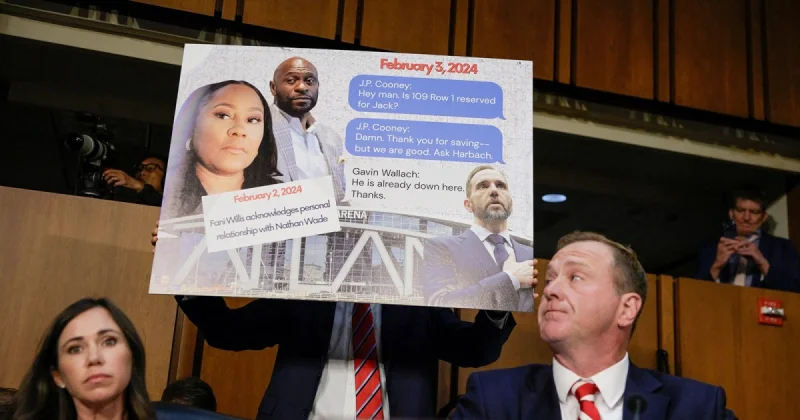
Eric Schmitt used Justice Department texts during Jack Smith’s hearing even after Senate Judiciary Committee staff warned his team the material had not been vetted. The allegation he built from them fell apart within minutes as C-SPAN showed the exchange live.
The episode turned on a narrow but important point: Schmitt was not relying on a finished record, but on texts his own side had been told were unvetted. Even so, he pressed them as proof that Smith had colluded with a Georgia state prosecutor, and he also insisted that Smith attended an Atlanta Hawks basketball game in February 2024.
That made the hearing look less like a search for facts than a test of how far a charge could go before the record caught up. Republican staff on the Senate Judiciary Committee had received materials from the Department of Justice before the hearing, and Chuck Grassley’s team assembled a memo around key information without including the texts. Grassley also did not share them with Democratic senators before the hearing, leaving them out of the room when Schmitt’s line of attack was taking shape.

The friction point was not subtle. Schmitt’s staff had asked for material linking Jack Smith’s investigation to Fani Willis’ probe, and he used what he got anyway after staff had said the texts were unvetted. Democratic staffers suspected that congressional Republicans and the Trump administration were working together to undermine or trap Smith, and the hearing gave that suspicion fresh fuel even as the allegation itself collapsed on camera.
That collapse mattered because it fit a pattern Republicans have already faced in their search through special counsel records. Members had previously used internal communications from Smith’s office about subpoenas to accuse him of wiretapping GOP members of Congress, but the records did not back those accusations. The result was a live example of the risk in stretching raw material into proof before anyone has checked whether it holds up.
Neither Schmitt’s office nor the Justice Department immediately responded to a request for comment, leaving the brief exchange to stand on its own. What remains is the gap between what was in the texts and what Schmitt tried to make them say — the question his team never answered before the hearing moved on without him.