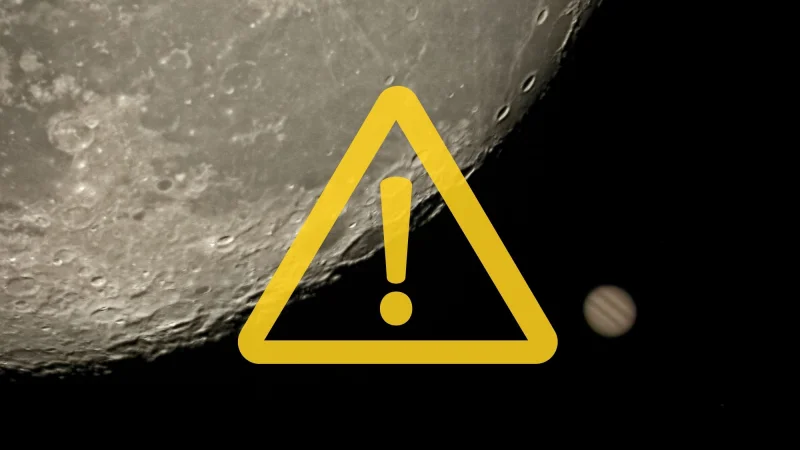
A waning crescent moon will pass directly in front of Jupiter before dawn on Oct. 6, briefly hiding the planet from view across parts of North America. The alignment will turn a familiar predawn pairing into a short-lived occultation, with Brilliant Jupiter slipping behind the moon's edge and then returning to view.
The event is drawing attention because it happens at a precise hour and cannot be seen everywhere. At around 2:30 a.m. local daylight time, the moon will rise in the east-northeast while it is just 20% illuminated, a little over four days from new phase. That puts the moon’s sunlit side near Brilliant Jupiter, giving observers in parts of North America a narrow window to watch the two bodies draw together before the planet disappears.

What makes the sight unusual is the contrast. Jupiter is one of the brightest objects in the night sky, yet on this morning it will vanish behind a moon that is still mostly dark. For skywatchers, that is the point: the moon is dim enough to make the planet stand out, but the geometry of the new phase means the lunar disk can still cover it completely for a time.
That also means the view is not universal. The occultation will be visible only across parts of North America, and the exact reach of the disappearance is not spelled out. Readers looking up on Oct. 6 will need the local sky to cooperate, because the Moon and Jupiter will need to be above the horizon at the same time before dawn for the event to be seen at all.
The sequence is simple once it begins: the moon rises in the east-northeast, moves toward Jupiter, and then crosses in front of it. Jupiter will reappear after the occultation, but the duration is not given. For observers in the right part of North America, that makes Oct. 6 a one-morning chance to watch a bright planet blink out and return behind a thin crescent moon.