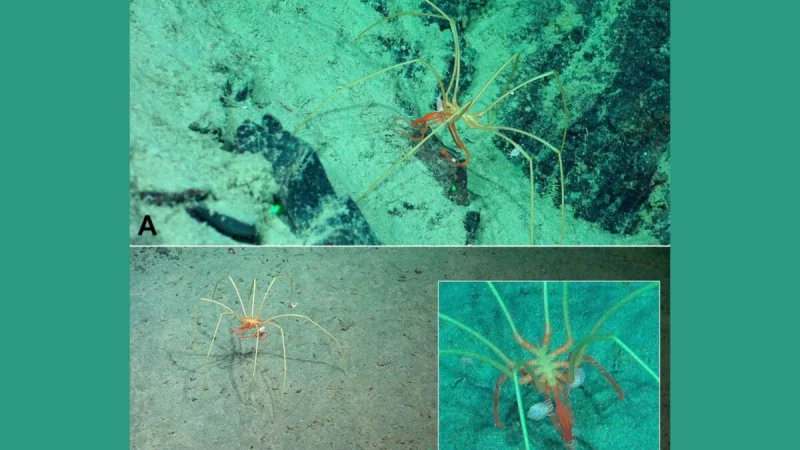
Marine biologists studying life deep in the Pacific Ocean spotted something they did not expect: shrimp-like amphipods riding on giant sea spiders. The encounters came in November 2024 during work along the Chilean margin in the southeastern Pacific Ocean, where the robotic submersible SuBastian recorded a sea spider carrying at least three amphipods at roughly 10,000 feet below the surface.
Four days later, the team saw another sea spider with amphipod passengers about 140 miles from the first sighting. The animals were identified as Colossendeis colossea, the largest known sea spider, and Mesopleustes abyssorum, the hitchhiking crustacean. The observations were published in Ecology, and they give a rare look at deep sea life behaving in a way that is easy to miss when the animals are not seen together in the wild.
That is why the findings matter now. Direct observation remains the only way to catch interactions like this in remote waters, and the researchers said the encounters underscore the value of going in person to unexplored deep-sea ecosystems. Sea spiders are arthropods, though they are not closely related to land spiders or other arachnids, and they are known to carry moochers that use their bodies for shelter or dispersal, usually stationary organisms. Amphipods are mobile crustaceans, which makes the pairing less obvious and more intriguing.

The friction point is simple: the scientists do not know whether the amphipods were using the sea spiders for transport, feeding or mating, and they do not know whether this kind of hitchhiking is common or limited to this encounter. That uncertainty is softened, but not erased, by the pattern they saw. They said the behavior may be commonplace, yet they also noted that this appears to be the first time anyone has directly observed these two species interacting this way. A researcher had described finding a Mesopleustes abyssorum attached to the same sea spider species in a 1927 paper, and a study last year reported the crustacean stuck to a different kind of sea spider.
So the most careful reading is also the most interesting one: this may not be a one-off accident, but the start of a clearer picture of how life moves through a hard-to-reach deep sea environment. What remains unresolved is not whether the animals can cling to one another, but what the relationship means when it happens more than once, in more than one place, and with the same crustacean in the frame.