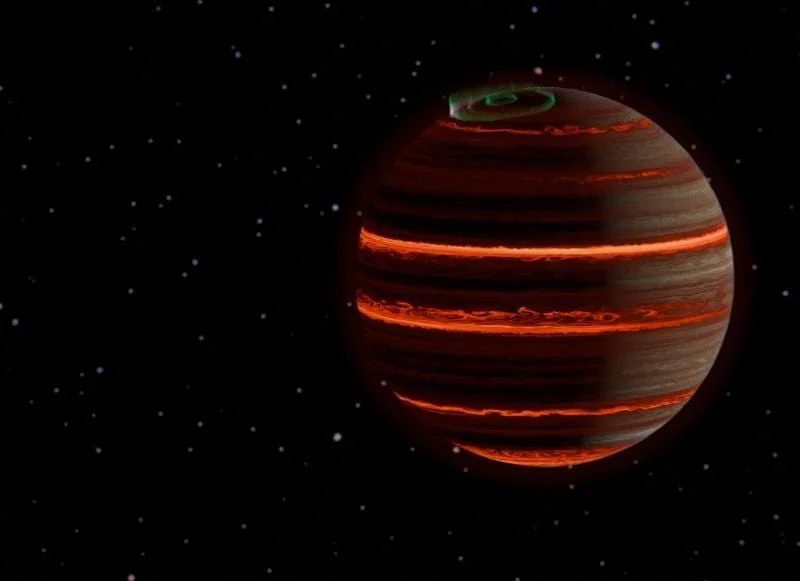
Researchers using the James Webb Space Telescope have decoded the Planet Weather on SIMP J0136+09, a distant brown dwarf also known as SIMP 0136, by tracking how its light changes as it rotates. The analysis points to temperature shifts and changing cloud structure as the main forces behind the object’s fast-moving atmosphere.
The work matters now because it turns raw brightness variations into a weather map. SIMP 0136 lies about 20 light-years from Earth in Pisces, and its atmosphere produces minute changes that can only be teased apart with Webb’s time series observations and low-resolution spectroscopy from the General Observer Program 3548. The team used the Near-Infrared Spectrograph and the Mid-Infrared Instrument, then applied Principal Component Analysis, or PCA, to keep only the variables that move together and set aside the rest.
That method gave the researchers a way to separate changing brightness patterns from noise. By reducing the data to the dominant components, PCA showed that the fluctuations were not random; they were tied to weather systems sweeping across the brown dwarf’s surface. The paper describing the results appeared in Astronomy & Astrophysics and says the atmosphere’s observed changes can be explained by three recurring weather patterns.

Those patterns matter because they point to a specific atmospheric structure. Some regions are hotter and carry thinner clouds, while others are cooler and have thicker, vertically extended clouds. That mix helps explain why the object’s brightness changes so quickly and why the weather on SIMP 0136 looks so different from a calm, uniform sky. The object is larger and hotter than a gas giant, but it is not massive enough to have collapsed into a star, which is why astronomers classify it as a brown dwarf rather than a planet.
Merle Schrader said SIMP 0136 is one of the easier brown dwarfs for the team to capture high-quality data from, which made it a useful test case for the new technique. She said the method helped show how the weather patterns interact and co-exist, and also offered a way to refine the approach for use on less well-known brown dwarfs. Johanna Vo said the findings will change how astronomers analyze future JWST observations because the approach quickly identifies the dominant atmospheric components before more demanding modeling begins.
The broader value is straightforward. SIMP 0136 is directly imaged and already well studied, so it gives astronomers a rare place to test how cloud formation, atmospheric circulation and heat transport work under extreme conditions. The open question is how far this three-pattern model will travel beyond this object. The team says the method can be applied to other brown dwarfs, but the next targets will decide whether the result is a one-off success or a tool the field can use more widely.