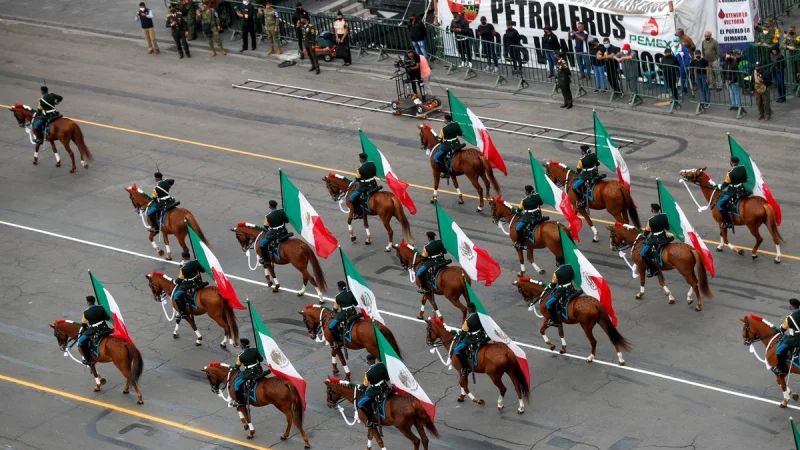
Mexico will mark The Cry Of Mexico on the night of September 15, and this year Claudia Sheinbaum will stand on the balcony of Palacio Nacional to ring the bell and lead the national Grito for the first time as president. The ceremony will again unfold on the eve of Mexico’s official Independence Day, with the country turning to a ritual that mixes memory, pageantry and politics in a single night.
That timing is why the custom draws attention now. The Grito is not a random patriotic performance moved by habit; it is the ceremony Mexicans watch each year because it sits at the center of Fiestas Patrias, and because Sheinbaum’s first presidential Grito gives the ritual a new face in 2025. In the United States, Mexican and Mexican American communities will also gather around the same tradition in plazas, consulates and festivals, keeping the night of September 15 tied to a shared civic calendar that stretches beyond Mexico.
Sheinbaum’s role follows a fixed sequence. The president emerges on the central balcony of Palacio Nacional, receives the Mexican flag, rings the bell and then calls out the names of figures from the independence struggle, with the crowd answering “¡Viva!” The ceremony closes with three vivas to Mexico, the Himno Nacional and a light or fireworks show. In her first presidential Grito in 2025, Sheinbaum also included recognition of women Indigenous people, migrant communities, anonymous heroines and values such as freedom, equality and justice, giving the familiar ritual a broader political language without changing its structure.

The question that has long followed the celebration is why it happens on September 15 when Mexico officially commemorates Independence Day on September 16. Historical testimony shows nighttime celebrations were already being observed by 1824, which undercuts the popular claim that Porfirio Díaz shifted the ceremony to match his birthday. Díaz did help turn the Fiestas Patrias into a major national celebration, but the evidence points to a custom that was already rooted in the evening before his era, not one invented by him.
The deeper source of the night lies in the original Grito de Dolores. In the early morning of September 16, 1810, Miguel Hidalgo y Costilla rang the bells of his parish in Dolores, gathered residents and called on them to rise up against the authorities of the Virreinato de Nueva España. That call began a war that lasted more than a decade, and it is why the modern ceremony still treats the bell, the crowd response and the patriotic shouts as a national act of remembrance.
What is spoken now is not a verbatim echo of 1810. There is no definitive transcription of Hidalgo’s words, and the current arenga is a commemorative recreation rather than a literal quote from that morning. The exact phrasing may be lost, but the meaning is not: the ritual continues because it links the presidency, the public square and the memory of revolt in a way no written script can fully capture. Univision will also air the special ¡Viva México, Fiesta Mexicana! on September 15 starting at 11:35 p.m. Eastern Time and 10:35 p.m. Central Time, with the transmission also available on ViX.
That is why Sheinbaum’s first Grito matters beyond the balcony itself. It is the newest turn in a ceremony that has already traveled from Dolores to Palacio Nacional and from Mexico to communities in California, Texas and the wider United States. The unanswered piece is not whether the ritual will continue, but how each presidency keeps remaking the same cry without breaking the thread that makes it Mexico’s own.