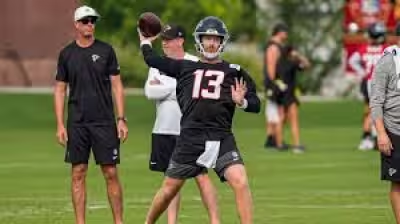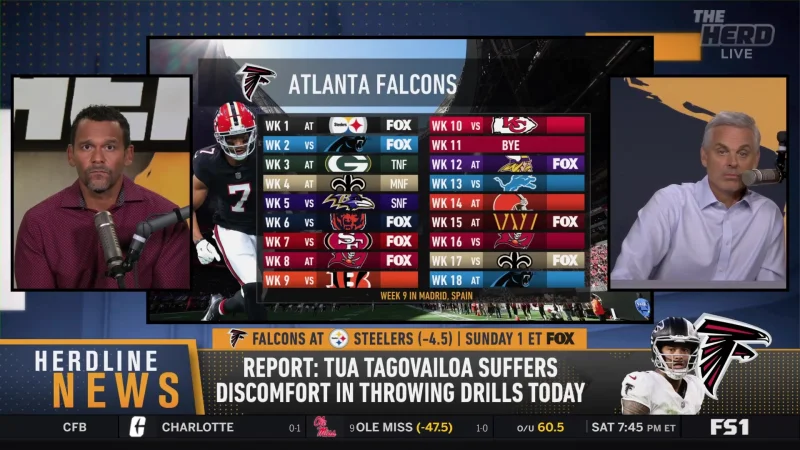
The Falcons schedule is already drawing early attention because a fresh 2026 forecast sees Michael Penix Jr. finishing the year as the starter. That projection puts him at the center of a season that looks less like a finished product and more like a test of whether Atlanta can keep moving forward while the roster changes around him.
People are looking at the Falcons schedule now because the team’s path is known, and the opening run is unusually demanding. The forecast points to three straight primetime games early in the season, the kind of stretch that can shape the tone of a year before it settles into a rhythm. It is also the kind of slate that makes every quarterback decision feel larger than it might later on.
The projection leans into that uncertainty. Atlanta is expected to give Penix every opportunity to prove himself, but the offense may begin with Cooper Rush for at least a week or two before the job turns back over. That is the detail that gives the prediction its edge: the season is not framed as a clean handoff, but as a search for stability while the team figures out who it really is.

The win total attached to that idea is modest but not dismissive. Eight victories is the number on the page, and it is paired with the suggestion that eight wins might still be enough to claim the NFC South. That makes the forecast less about contention in the broadest sense and more about surviving a division race that could stay open longer than it should.
The defense only sharpens the uncertainty. Jalon Walker is projected to be out for the season, and James Pearce Jr. is expected to miss half of it, which leaves the front end of the year exposed while the team leans on a defense described as aggressive and fundamentally sound. That is a workable formula on paper, but it also invites big plays if the pressure does not arrive fast enough.
There is more upside on offense than the record projection suggests. Bijan Robinson is viewed as a player who could put together a legitimate MVP-caliber season, and rookie Zachariah Branch was added to the wide receiver group. Those are the kinds of pieces that can keep an offense afloat even if the quarterback picture changes again before it settles.
That is why the forecast treats 2026 as a transitional year for the Falcons. The team looks built to spend part of the season learning what works with Penix, part of it getting through the early stretch with Rush, and all of it trying to stay close enough in the NFC South to make the record matter less than the finish. The most important question may be whether Atlanta is setting itself up for a respectable year now or a much more aggressive push in 2027, when the next roster moves could come fast.