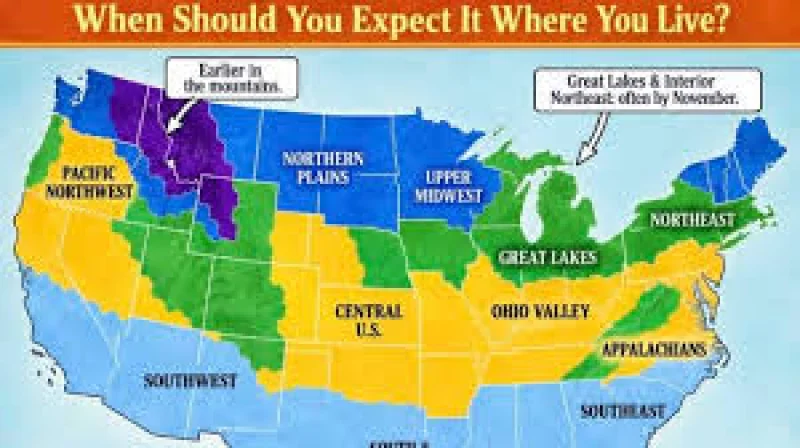
The Farmers' Almanac has released a map showing when the typical first snowfall is expected across the United States, turning an old seasonal curiosity into a fresh guide for the weeks ahead. The timing runs from dustings already showing up in higher terrain to first measurable snow that may not reach some places until late fall or early winter.
That matters now because the season is already starting to show its edges. Mt. Bachelor near Bend, Oregon, got a dusting on Sept. 2, and the National Weather Service said on Sept. 10 that confidence was growing that the first impactful snowfall of the 2026-2027 snow season would occur this weekend. In Great Falls, Montana, forecasters said there was a 40% chance of 4 inches or more at the higher elevations of the Rocky Mountain Front in Montana, while AccuWeather said some ridges and peaks in the Cascades and Olympic Mountains may receive accumulating snow this weekend.

The map is not presented as a storm warning. The Farmers' Almanac calls it a climatological guide rather than a forecast for one particular storm, which is the key to reading it correctly. Its value is in the average pattern it sketches out: parts of Oregon, Washington, Idaho, Montana, Wyoming, Minnesota, North Dakota, South Dakota and Wisconsin typically see their first measurable snow in October or early November, and much of the northern Rockies, northern Plains and Upper Midwest usually follow the same window. By October, the publication says, the first measurable snow becomes increasingly common across that stretch of the country, and that timing lines up with expectations from the National Oceanic and Atmospheric Administration for the region.
Farther east, the timing is later. The Farmers' Almanac expects Delaware's first measurable snowfall from late November to December, and Kevin Brinson said the mean date for the first measurable snowfall in Wilmington, Delaware is Dec. 15. In Michigan, the publication puts first snowfall in November, which matches work from the Midwestern Regional Climate Center showing that much of Michigan records average first snowfalls in November, though some parts get snow in October and it is not unheard of in September. Georgia is listed as rarely getting snow, even after coming off a winter with multiple storms, including some snow in Atlanta.
That gap between the map and the weather outside is what gives the release its bite. An early mountain snowfall does not automatically mean a hard winter has begun. The Farmers' Almanac says an August or September mountain snowfall does not necessarily mean winter has arrived for good, and early snow often melts quickly when warmer weather returns. For readers, that leaves two truths standing at once: the season is opening in the highest terrain first, and the first real test for the map will come when the next round of snow either sticks or slips away.