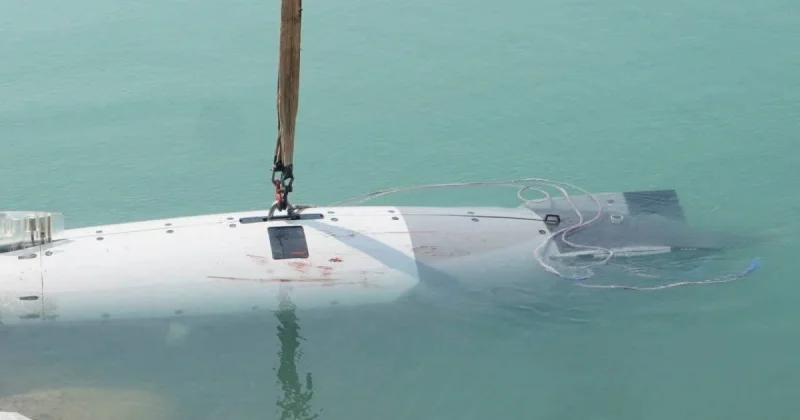
Iran's Islamic Revolutionary Guard Corps said its naval forces captured an unmanned United States submarine near the Strait of Hormuz on Tuesday evening, a claim that immediately collided with Washington's account that the vessel had already failed a day earlier. The object at the center of the dispute is Dive-LD, an autonomous underwater vehicle built by Anduril Industries and described as a system meant to work where loss is expected.
The timing is why the search for U.s. Submarine Captured Iran is spiking now. The Strait of Hormuz is a crucial waterway connecting the Gulf and the Arabian Sea, and the incident lands amid exchanges between Iran and the United States over ships in the same region. The US military said on Tuesday evening that it destroyed five Iranian crude oil carriers after Iran attacked a US Navy warship with ballistic missiles, while Iran said it attacked two US vessels and eight oil tankers.

The IRGC said its naval forces had trapped one of the most modern, intelligent, unmanned submarines of the US military at the entrance to the Strait of Hormuz and described the operation as a complex intelligence and operational mastermind operation at dawn. Iranian state media identified the vessel as Dive-LD, a six-metre autonomous underwater vehicle designed for long-duration missions including surveillance, seabed mapping and mine detection. Anduril Industries says Dive-LD can reach depths of 6,000 metres and stay under water for up to 10 days, with missions that can also include intelligence, surveillance, reconnaissance and precision placement.
That is where the story splits. An unnamed Pentagon spokesperson told that the submersible had been lost while it was sent to survey regional waters in support of ongoing operations, and said the defective drone was an older model that did not collect sensitive data or carry any classified sonar or radar equipment. Anduril Industries later said Dive-LD is an attritable autonomous system built for dangerous environments, where losing the vehicle is part of the design, which makes the question less about the hardware itself than about who actually had hold of it after the malfunction. What remains unclear is whether Iran physically recovered the Dive-LD or only tracked and identified it after it had already gone dead.