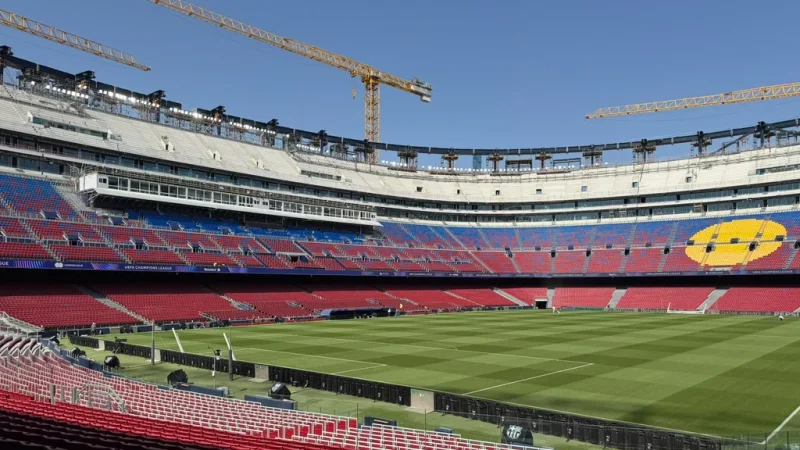
FC Barcelona walked back into Camp Nou on 22 November 2025, 909 days after its last match there, but the homecoming came with scaffolding still in place and major parts of the rebuild still unfinished. The club’s return to the stadium for Barcelona Vs Feyenoord is a milestone, not a finish line.
That is why the match is drawing attention now. FC Barcelona spent more than two years away from Camp Nou after the first preparatory work began in 2022, and from the start of the 2023/2024 season it had to play at the Olympisch Stadion on Montjuïc instead. The temporary move was never meant to last this long, and the club originally hoped to be back by the end of 2024.
The scale of the project explains the delay. The renovation is expected to cost about 1.5 billion euros, and the third ring of Camp Nou was fully demolished and rebuilt during the work. But one of the biggest jobs is still not done: the roof, described as the major problem in the renovation, has yet to be installed. It is planned as a large cable construction of 48,000 m³ with a walkway on top for fans, a piece of engineering that underlines why the stadium is still more worksite than finished arena.

Edwin Winkels, who lives just outside Barcelona, said the plan had always been sold as a short disruption before a quick return. “The idea was that they would have to leave for just a little while, and then come back within a year to a fully renovated stadium,” he said. Instead, the project has stretched far beyond that promise, and the current target for a full opening is now begin 2028.
Winkels said the delay came from a decision that backfired. He said the club signed with a Turkish construction company and passed over two Spanish giants because the Turks promised to finish quickly. “That was a miscalculation,” he said. Even so, he added that the fans are taking it relatively calmly, which helps explain why the return to Camp Nou feels celebratory even while the stadium remains unfinished.
The tension is obvious in the structure itself. Workers and cranes are still visible around and inside Camp Nou, the third ring is still not fully complete, and the blaugrana seats have not yet been installed in the highest tier. Locals have started comparing the project to a new Sagrada Familia, a joke that lands because the original Sagrada Familia began in 1882 and is still unfinished today.
For now, the important fact is that FC Barcelona is back at Camp Nou, but not back in a completed home. The club has resumed playing there while the last and most difficult stages continue, and the question that matters is not whether the stadium reopened for one night, but whether begin 2028 is a deadline the project can actually meet.