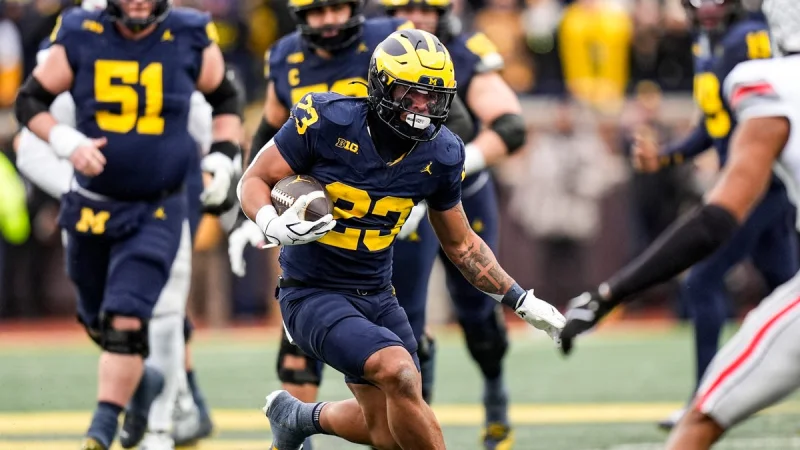
Jordan Marshall did not wait for preseason camp to make sense of Michigan's new offense. He called it explosive and tricky, a quick read of the direction Jason Beck is trying to take the unit as the Wolverines open a season with a new play caller and a fresh identity.
That is the kind of label that gets attention because Marshall is not speaking from the outside. He is Michigan's returning leading rusher, and his view lands at a moment when the offense is expected to lean harder on the run and ask Bryce Underwood to do more as part of that ground game. Marshall also said there is an element of surprise to the offense, which is the kind of phrase players use when the structure feels different before the first snap of camp.
Beck has spent the offseason talking about a more physical offense that is harder to defend and built to attack defenses without becoming predictable. He said the system is designed to use a wide range of personnel, formations, motions and play types while keeping tempo. That is how the offense can look tricky without depending on a pile of gadget plays. The deception comes from structure, speed and the strain it puts on a defense that has to react before it has fully identified the look.

There is a reason Michigan thinks that approach can work. Beck brought a run-heavy model with him after leading Utah to finish No. 4 nationally in offense and No. 2 in rushing in his lone season there, and Utah averaged 266.3 rushing yards per game. Michigan's backfield gives him options on paper: Marshall is back, Savion Hiter arrives as a five-star freshman and Bryson Kuzdzal returns as a veteran. The question is not whether there is talent there. It is how Beck sorts the touches once the games begin.
That same uncertainty hangs over the rest of the offense. Bryce Underwood is back for his sophomore season and second year as a full-time starter, and Koy Detmer said he looks a lot more comfortable. Michigan also has a backup quarterback battle that has been described as neck and neck between Tommy Carr and Brayden Fowler-Nicolosi, which makes the quarterback room competitive enough to matter even if the run game stays the center of gravity. If Beck gets the balance right, the offense could look faster and harder to key on than it has in recent seasons.
The wrinkle is that Michigan still has not had a 1,000-yard receiver since Jeremy Gallon in 2013, and that makes the choices in this offense feel even sharper. Andrew Marsh led the team last season with 651 yards on 45 catches and four touchdowns, then set a goal of reaching 1,000 receiving yards and winning the Biletnikoff Award. For now, though, the early read is simpler than the long-term goals: Marshall sees an offense that can keep defenses guessing, Beck says it is built to punish them, and camp will show whether the surprise is real or just the sound of a new system taking shape.