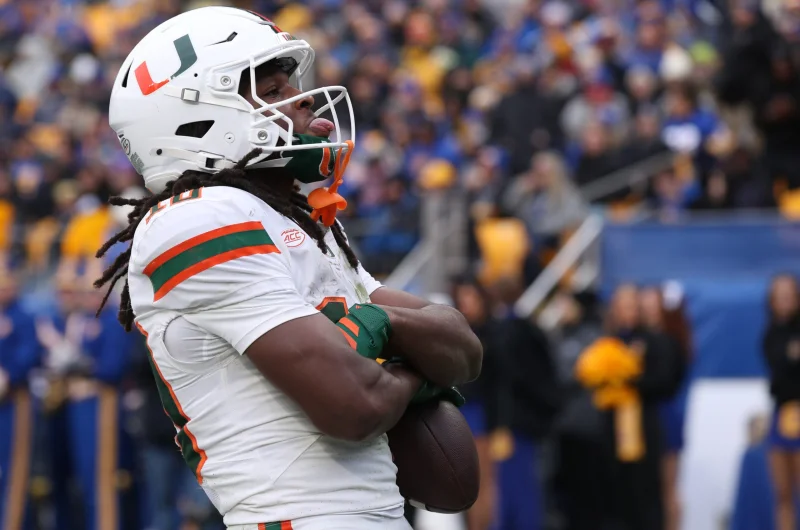
’s Pamela Maldonado put Malachi Toney at 38-1 in the Heisman Trophy market, a long shot with a real opening if Miami’s offense breaks the right way. The freshman receiver is being talked about now because the season-opening kickoff against Stanford is just over a week away, and the conversation around him is no longer about upside alone.
Toney is not being framed like a normal wideout. Maldonado’s case rested on production, then on the kind of usage that can turn a receiver into a weekly event. He caught 109 passes for 1,211 yards last year, produced 841 yards after the catch and added 298 punt return yards, with two touchdowns through the air and one on the ground. Miami also has been using him in the passing game, on the ground and in the return game through the “Mali-cat” package from Shannon Dawson, which is why his profile reaches beyond simple receiver stats.
The number that matters, though, is how high the ceiling has to climb. Maldonado said Toney would likely need something near 1,500 yards and 15 scores, plus possibly a playoff appearance, to make the award race real. That is a high bar for any receiver, and it is why she pointed to Ohio State’s Jeremiah Smith as the cleaner bet at 14-1. Her point was not that Toney cannot get there. It was that a receiver needs overwhelming production and a story that belongs to him.
That is where the friction enters. Maldonado said quarterback Darian Mensah could receive most of the credit, even if Toney does the heavy lifting on the field. If the offense explodes, the quarterback usually gets the loudest applause, and receiver candidates can lose the narrative before they lose the stat race. Maldonado said Toney would also need the Hurricanes to contend without Mensah absorbing the narrative, a harder task than piling up catches.
Miami has lived this before, and not recently enough to make the idea feel routine. The Hurricanes have won the Heisman Trophy twice, with Vinny Testaverde in 1986 and Gino Torretta in 1992, and both of those teams fell in the national championship game. The program has gone 34 years without another winner. Last year’s team reached the national title game and lost to Indiana 27-21, which only sharpened the sense that a big individual season still has to come wrapped in team success.
That is why Toney’s candidacy matters now, not as a slogan but as a test. He is being asked to do the rare thing a receiver must do: separate himself from the quarterback, the system and the usual assumptions about how award voters think. If Miami opens the season the way it hopes, Toney will not just be a useful weapon. He will be the player who has to make a 38-1 number look small.