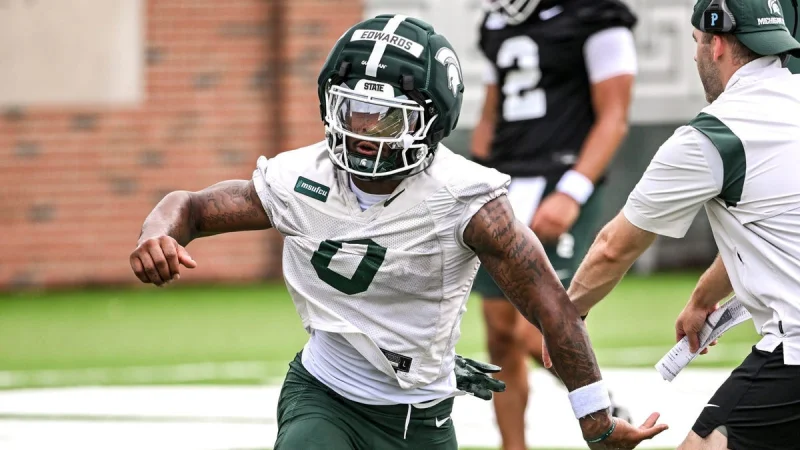
Cam Edwards opened his senior season at Michigan State with a target as big as any in the Big Ten: he wants to be the best running back in the country. He also set three other goals for the year — win a lot of games, win a Big Ten championship and win a national championship — putting his final season on a sharp, public clock.
That matters now because Edwards is not speaking in the abstract. He is a fifth-year running back entering a season in which Michigan State is expected to lean on him, and the standard around him has already been drawn higher by Pat Fitzgerald, who said, "We expect him to be the best running back in the country."
Fitzgerald did not stop there. He said Edwards has "every bit the talent to be the best that I’ve ever coached," a line that gives the senior season real weight before a snap has been played. Edwards also described the daily measure he uses to judge himself, saying he checks his stats on every Sunday morning to see how far he has to go before he can call himself the greatest. That kind of self-scoreboard fits the kind of player Michigan State is asking him to be.

The belief around Edwards did not start in East Lansing. He grew up in Norwalk, Connecticut, in an apartment complex where football was woven into family life and neighborhood routine. His mother lived with him, while his grandmother Linda and uncle Terron Edwards lived across from them. Terron said a Sunday afternoon incident — when Cam climbed out of a car seat and off a bed — led him to put the child in front of the TV to watch football, and the game he remembered was between the New England Patriots and the Cincinnati Bengals.
Edwards said his father, Aaron Collins, put a basketball in front of him first, but it was his uncle who kept pulling him toward football. He remembers that pull as simple and lasting. "I just fell in love with the game of football," he said. The neighborhood helped turn that interest into habit, with kids playing football on Sunday nights on the blacktop and a game called City Tag adding another layer to the competition.
That past makes the present feel heavier. Edwards is chasing a standard that only exists if he meets it, and Fitzgerald is asking the same question in different words: how many chapters of this season will the senior write with the talent he has already shown? The answer will come on the field, where the goals are clear and the margin for calling them reality is still unearned.