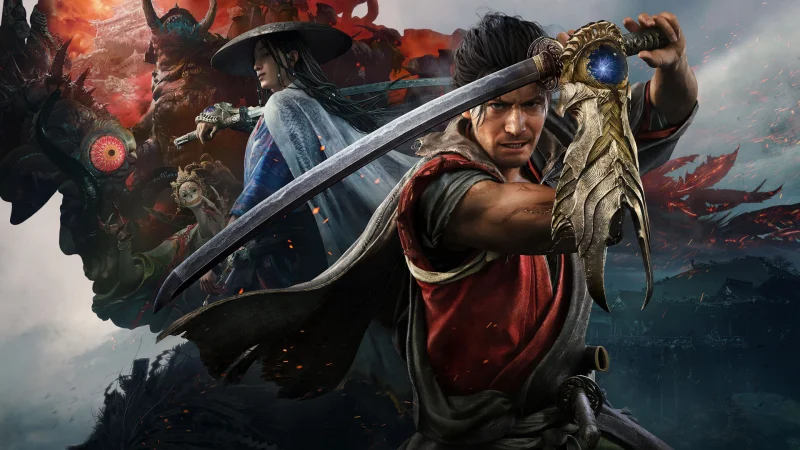
Ahead of launch, Onimusha: Way of the Sword has been played through, and the first hours make one thing plain: its swordfighting is built to feel sharp, fast and unusually responsive. Miyamoto Musashi can move from attacks to parries and back again without breaking rhythm, and that back-and-forth is the game’s real hook.
That matters because the opening stretch is not a single tutorial encounter dressed up as depth. Within the first couple of hours, the game gives players multiple ways to handle enemies and bosses, from a Genma footsoldier to a multi-stage boss. Holding LB blocks most attacks, even ranged ones, from any angle, which makes it sound like the obvious answer. But it is usually the wrong one to rely on for long. Every blocked hit costs stamina, and if that meter empties Musashi loses his stance and a healthy chunk of souls. In other words, defence is useful, but passive defence is expensive.
The stronger tools reward cleaner timing. A standard parry leaves an enemy helpless for a few precious seconds, which opens the door to attacks that matter more than simple chip damage. Parrying enough blows fills the Blaze Gauge and pushes Musashi into Blazing State, where hits can do more health damage, more stamina damage and earn extra souls, while the game throws in a sharp visual effect. It is the kind of system that turns well-timed defence into momentum, not just survival.

That same design shows up in the more advanced mechanics. A Deflection happens when the player blocks and presses A as an attack lands. It does a huge amount of stamina damage and can eventually lead to a Break Issen, which kills most weak enemies outright and can cut bosses down far faster. Deflections can also send projectiles back where they came from. Then there is Issen, which asks for an attack to start in the precise moment before an enemy blow lands. Get it right and Musashi effectively teleports to the side to land one of his strongest strikes. A Barrage begins when an attack lands at the same time as an enemy’s, and then the player has to answer with the opposite attack button from the one that started the exchange. A Lock can begin after a parry or a deflection, and hammering X or Y wins it, sending the opponent spinning away with missing stamina.
That is why the game’s combat feels exceptional rather than merely busy. It is not asking players to stand behind a guard and wait, but to keep changing gears, reading the enemy and choosing the right timing-based answer. The preview is a combat report rather than a release-date update, which leaves the launch date itself unresolved. For now, the clearest thing on the page is the design goal: Onimusha: Way of the Sword wants every fight to feel like a small test of timing, and Musashi is built to pass it.
For readers following the series closely, that focus also fits the broader picture in our Onimusha: Way Of The Sword review and earlier coverage of the game’s technical targets on Nintendo Switch 2, but this hands-on look is narrower and more immediate. It does not dwell on story or platform detail. It is about whether the blade feels good in the hand. On that question, the answer from the first couple of hours is yes.