LUX-ZEPLIN has reported one unusual particle interaction in its dark matter search, a result researchers say is the strongest hint yet from the experiment but still far short of a discovery. The event turned up in 220 live days of data collected between March 2023 and April 2024.
The signal matters because the detector is built to find dark matter, the unseen substance thought to make up roughly 85 percent of the universe’s mass, and because this was the first time the collaboration had seen anything in this part of its search that it could not easily trace to normal matter backgrounds. In a scientific talk at the 2026 TeV Particle Astrophysics conference in Japan, researchers said the paper will be posted on arXiv and then submitted to Physical Review Letters.
Rick Gaitskell said the team was “very intrigued” to see the event in the region where dark matter should appear and where competing backgrounds are low. He also said the collaboration is not claiming to have seen dark matter and does not want to get ahead of itself. That caution sits alongside a real point of weight: this is the most compelling hint of dark matter the experiment has reported so far.

The result came from a broader analysis than the group’s earlier search for the simplest WIMP interactions. This time, the collaboration looked for a wider range of possible weakly interacting massive particle interactions that could dump more energy into the detector. If the event does come from dark matter, it would likely involve a WIMP with a mass of at least 200 GeV/c2, more than 200 times the mass of a proton.
Sam Eriksen said the study focused on a region the team had not explored in this dataset and that it spent months of extra effort working through every possible source of background events. That is the friction point in the result: the detector is sensitive enough to make a single event matter, but not yet sensitive enough to say what caused it. The collaboration of 250 scientists and engineers from 39 institutions still has only one unexplained interaction to work with.
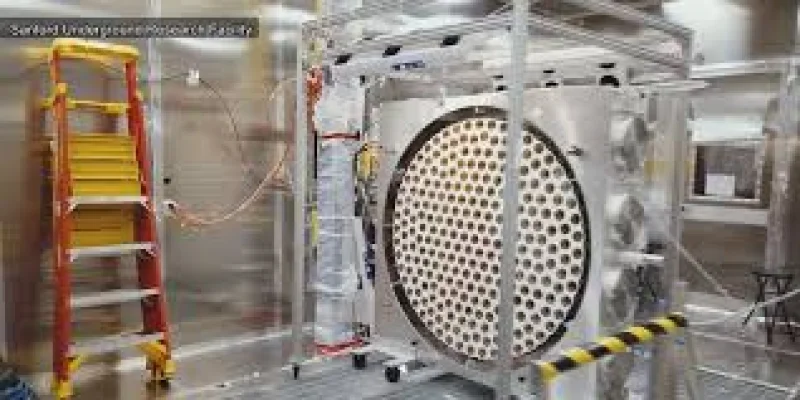
LUX-ZEPLIN operates nearly one mile below ground at the Sanford Underground Research Facility in South Dakota, using 10 tonnes of ultrapure liquid xenon to look for WIMPs, a leading dark matter candidate that has never been directly detected. Supported by the U.S. Department of Energy’s Office of Science, the detector is managed by DOE’s Lawrence Berkeley National Laboratory. For now, the question is not whether the signal is dramatic enough; it is whether more data will show that it was dark matter at all.