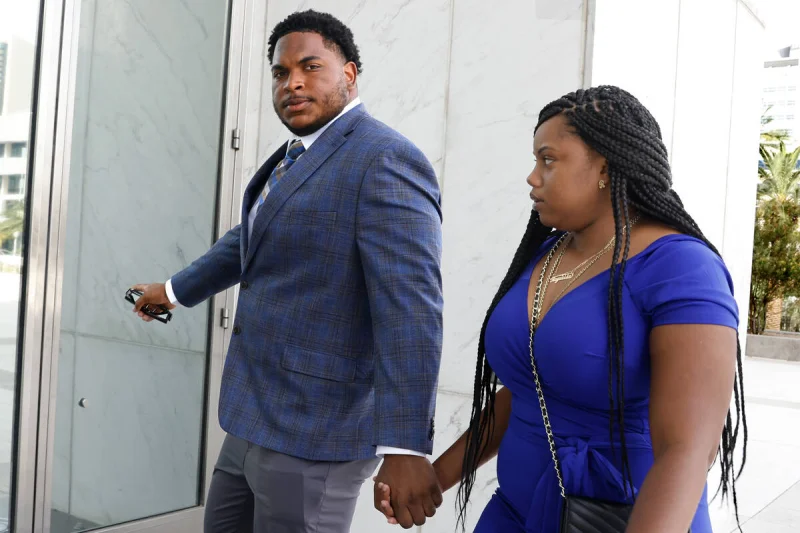
A federal judge on Friday denied Cohen Fuller’s request for a temporary restraining order, leaving the UNLV defensive lineman currently ineligible to play on the eve of the team’s season opener. UNLV said the ruling means Fuller cannot suit up Saturday against the University of Memphis.
That makes the timing hard to miss for UNLV football. The team was set to open the season Saturday, and the question over Fuller’s availability had been hanging over the program after the NCAA had already denied his waiver and said he had used up his eligibility. Fuller sued the NCAA in June after it said he had exhausted his eligibility after playing at UNLV for the 2025 season.
Chief U.S. District Judge Andrew Gordon said Fuller had not shown a likelihood of success on the merits of his case. He also told the sides, “Mr. Fuller, I’m sorry,” before adding, “Best wishes. I hope things work out.” UNLV later said, “With today’s ruling, Cohen is currently ineligible to play.”
The case has moved through a shifting set of rulings that left Fuller’s status unsettled right up to kickoff. Denver U.S. District Judge Charlotte Sweeney ruled on July 31 that many players who graduated from high school in 2022 and ran out of playing time under NCAA eligibility rules could compete in a fifth season, and the NCAA has adopted new eligibility rules that allow five seasons of competition over a five-year period. But a federal appeals court paused the injunction before UNLV’s season opener Saturday against the University of Memphis, and Gordon’s denial pushed Fuller back out.
Fuller’s lawyers, Geoffrey Tabor and Tim O’Reilly, said the challenge was based in part on the fact that he spent a season at the junior college level and another at the National Association of Intercollegiate Athletics level. Tabor said, “And certainly, he wants to play, his teammates want him to play, his coaches want him to play.” O’Reilly argued that “Players are not purely fungible and are not simply replaced by other players who are eligible” and that “Not all players are the same, perform the same, or impact their teams and the market the same.”
The NCAA’s lawyers countered that the roster math matters as much as the eligibility math. They said only eleven Rebels at a time can take the field on Saturday, and if Fuller is among them, someone else will not be. They also argued, “Plaintiff argues every game he misses is a loss of experience,” but “the same is true for the other properly-eligible athlete whom Plaintiff will displace if Plaintiff is granted a (temporary restraining order) despite being ineligible.”
Fuller has now been ruled out for the moment, but the practical question is still in UNLV’s hands: whether the team keeps him off the field or decides to risk playing him anyway. With the opener against the University of Memphis next, the program’s first game now doubles as its first eligibility decision.