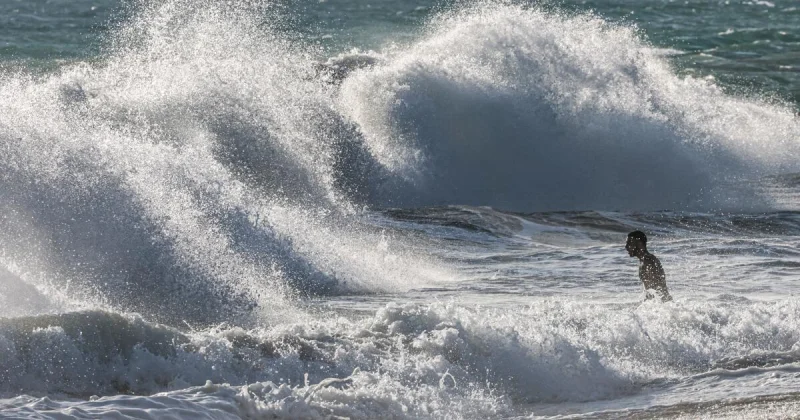
A rare blend of a powerful El Niño, super king tides and long-term sea level rise is lining up to threaten California’s coast with record flooding this winter. The danger is not theoretical. Officials are already seeing higher tides than usual, and waves are chewing through beaches, parking lots and bathrooms while old coastal infrastructure reappears in the surf.
The reason the warning is landing now is simple: a super El Niño is now 95% likely to develop this year, and that lines up with a coast that is already elevated by rising seas. Jonathan Warrick said waters offshore California can rise up to a foot, sometimes more, higher than average during El Niño, while Daniel Swain said the single-highest sea levels on record are quite possible this winter in California.
That matters because California has already been climbing toward a higher baseline. Over the past 125 years, the average sea level in San Francisco Bay has risen by about 1 foot, and the region has already set monthly records during the very strong El Niños of 1982-83 and 1997-98, as well as during the strong El Niño of 2023-24. This year’s setup could push the coast into the same territory again, only with stronger background sea level rise underneath it.

El Niño itself is the warm phase of the Pacific Ocean’s central and eastern tropical waters, and it has already been lifting seas far from California. In June, NASA showed sea levels more than half a foot higher than baseline off the Pacific coast of Peru, Ecuador, Colombia and Panama. Swain said water levels were already half a foot to a foot above average along much of the South American Pacific coast, and were approaching or exceeding a foot above average in Central America, up the west coast of Mexico and into the Gulf of California.
California is also dealing with damage that is arriving before the full force of the season. Parts of the coast have been seeing a marine heat wave unrelated to El Niño for months, and the most recent heating off Southern California within the week of August 15th may finally reflect more direct warming from El Niño drivers. That means some of the coastline is already under stress before the stronger winter surf and higher tides arrive.
Warrick said higher seas are a concern for coastal erosion, wave impact on cliffs and other structures near the shore, and flooding, especially because higher water makes it harder for rain to drain away. That is the hard edge of the forecast for California: lower-lying homes, beaches, parking lots, bathrooms and other coastal structures could be hit by a winter that is both wetter and more destructive than usual. The open question is not whether the coast will be tested, but how much more damage it will take once El Niño reaches full strength.