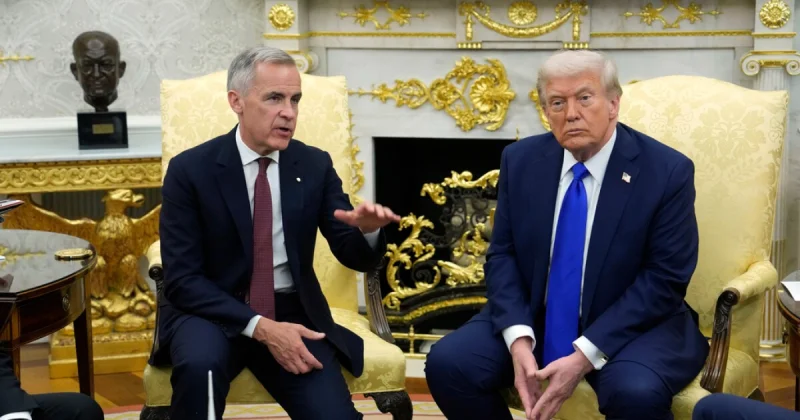
Donald J. Trump said Tuesday morning that the United States is giving serious consideration to renaming Lake Ontario to Lake America, pushing a trade fight with Canada into one of the oldest place names in North America. He said the move was being weighed because the United States no longer expects to do much business with Ontario.
Trump posted the message on Truth Social at 7 a.m. and paired it with a familiar threat: tariffs on Canadian cars, trucks and auto parts would double from 25 percent to 50 percent starting Jan. 1. He also said America had been carrying Canada for decades, but no longer, and added that the United States would always be far bigger, richer and stronger than Canada.
The target here is not just a lake. Lake Ontario is the smallest and most easterly of the Great Lakes of North America, bounded by Ontario, Canada, on the north and New York on the south. Its name goes back to a Wendat word meaning great lake or beautiful water, and European missionaries were recording it in the 1640s. When Ontario became a province of Canada in 1867, the province took its name from the lake, not the other way around.
That history gives Trump’s idea more bite than a passing insult. A formal name change would not happen by executive whim alone; it would run into long administrative and legal steps, and Trump has not said he intends to take any of them. For now, the renaming is a threat, not a policy.
The comment also landed in the middle of a broader pressure campaign. On Monday, Doug Ford told the that he had criticized Trump and threatened to cut off electricity and critical minerals to the United States, saying Ontario supplies electricity to 1.5 million American households and businesses. He also said Ronald Reagan would be disgusted with President Trump, after Ontario funded U.S. television ads last year using excerpts from Reagan’s 1987 warning that import tariffs can lead to retaliation and trade wars. Trump accused Ontario of misrepresenting Reagan and broke off trade talks, before Ford later agreed to pause the ads to get negotiations back on track.
There was also a split over language and culture. Mark Carney said on Monday that the Trump administration had threatened French language and culture during negotiations. Trump answered Tuesday by saying he would never interfere with Canadians speaking French and that he had never even thought of doing anything so stupid. That exchange matters because it shows how quickly the dispute has moved beyond tariffs and into identity, with Trump treating symbols as leverage and Canada treating them as red lines. Whether the Lake Ontario idea stays a taunt or turns into something official is the question that now hangs over the fight.