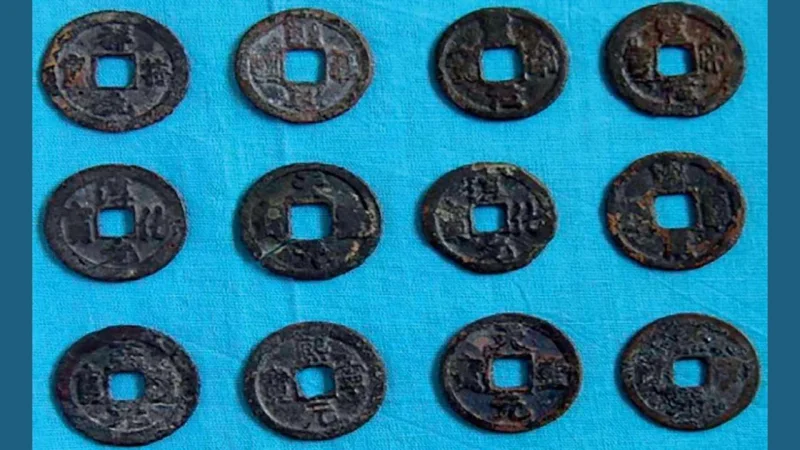
Coins recovered during the deepening of Kollam port in 2014 have now been identified as including Tang dynasty pieces, giving fresh archaeological weight to the port city’s long links with China. Of the 1,252 coins recovered in the work, five were conclusively identified as Tang dynasty coins, and the oldest was a bronze Qian Yuan Zhong Bao coin issued under Emperor Suzong between AD 759 and 762.
The identification matters now because claims that the Tang dynasty never existed have been circulating among young people and on social media in China. That makes the Kollam find more than a catalogue entry. It is a dated, physical record from the seventh to the 10th century, when Kollam stood on maritime trade routes between China and Persia and Chinese ships were said to have anchored there and paid duties.

Historians first linked the coins to the Tang dynasty, and the Archaeology Department later reached the same conclusion after examining their age. The coins are circular, have a square-shaped hole in the centre, were made with copper as the base metal, and were produced by the traditional mould-casting method followed in China. Those details helped separate the Tang pieces from other finds, including coins from the Northern Song and Southern Song dynasties that were also recovered from Kollam.
The find also undercuts the friction now surrounding Tang itself. Qiao Yu was reportedly the first to put forward the claim that the Tang dynasty never existed, and his account was later removed by the Chinese authorities. Against that backdrop, five coins from Kollam do not settle an online debate by themselves, but they do leave a hard archaeological fact in place: the Tang period left its mark far beyond China, and one of those marks was a bronze coin that can still be dated to Emperor Suzong’s reign.
The coins are currently preserved under the Department of Archaeology at the University of Kerala, where they remain the clearest material evidence yet of the connection between Kollam and China during the Tang period. If the claim circulating online is that the dynasty was only an idea, the question the coins leave behind is simpler and more stubborn: how many more such finds are still waiting in the record?