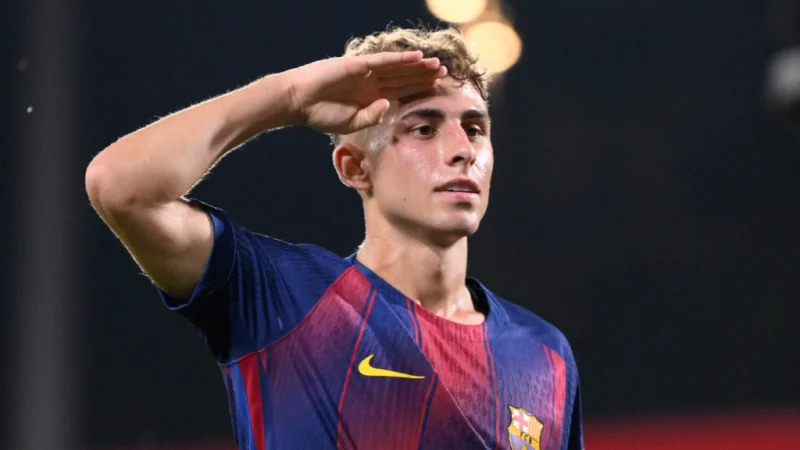
El Campillo is no longer just a quiet mining town in Huelva to football followers. It is the place where Fermín López was born, and that fact has turned the small municipality into part of the story around FC Barcelona’s current reference.
That attention sharpened after 2024, when López won the European Championship and the Olympic gold medal in Paris and the people of El Campillo welcomed him back. For residents of El Campillo, the link is not abstract: the player who now moves between club and country pressure remains tied to the place that shaped his early life.
The town sits in the Cuenca Minera de Riotinto, where its landscape mixes pine trees, eucalyptus trees, cereal fields and mountains. It grew out of the union of an old agricultural hamlet and the mining neighborhoods of Campo Nuevo, created to exploit the copper veins in the area. That origin still defines the setting around the Church Parish, the Dolmen de la Catalina and the Necrópolis de la Moraña, sites that help explain why El Campillo feels more like a rooted community than a dot on a map.

Its history also helps explain the town’s identity. In 1931, after becoming independent from Zalamea la Real, it took the name Salvochea in honor of the anarchist Fermín Salvochea. The record does not spell out when the old name returned, but today the municipality is known again as El Campillo, the name that now travels with López wherever he goes.
That is where the friction lies. López is still portrayed as someone who tries to enjoy local traditions when the calendars of Xavi or the Selección allow it, but those same demands limit how often he can come home. The Romería de la Santa Cruz and the Fiestas de San Juan «El Pitulito» remain part of the town’s rhythm, yet his appearances are now shaped by the demands of elite football rather than local routine.
For El Campillo, the reward is visibility. For López, the place remains a foundation, not a footnote. His rise has given the town a new audience, but the real measure of that connection will be whether the return trips stay possible when the calendar loosens enough to let him back to the streets where he began as Fermín López, the chaval.