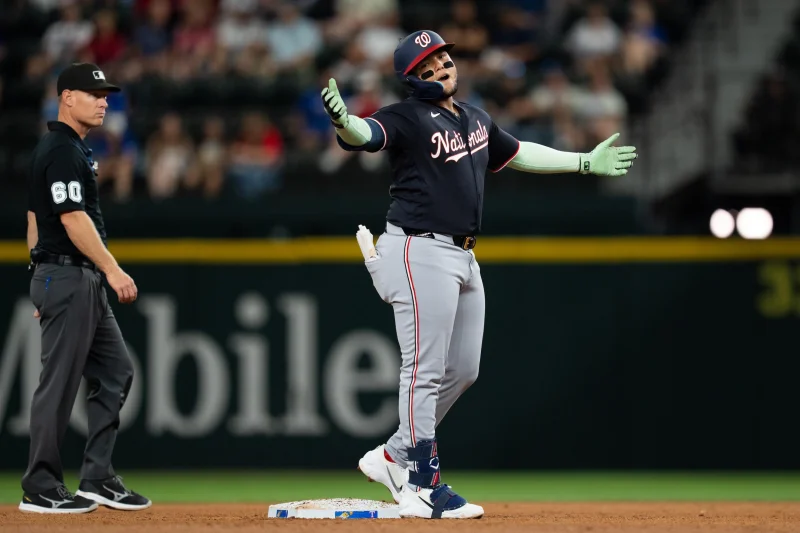
The Washington Nationals opened their series against the Miami Marlins with a lineup that looked nothing like the one they expected to carry them through the summer. Daylen Lile led off, Jorbit Vivas hit second, Nasim Nunez was back at shortstop while CJ Abrams recovered from an ankle injury, and Jacob Young returned to the lineup as Brad Lord took the mound after a brutal outing against the Mets.
That is the kind of night that tells you where a team really is. The Nationals had been shut out twice in the Rangers series and came in with an offense thinned by injuries and trades, so the search for runs had become as important as the matchup itself. They were trying to keep pace in the division, and they were doing it with a lineup that had been forced to change almost as often as the innings.

Lord was the center of that test. He was getting another start because the Nationals needed length and stability, even after the Mets had badly knocked him around, and he was facing a Marlins club with its own problems for opponents. Ryan Gusto was on the mound for Miami, while Otto Lopez and Xavier Edwards had been producing steadily from the middle infield and Griffin Conine had recently picked up his game, a reminder that the Marlins were not offering an easy landing spot for a pitcher trying to reset.
The friction for Washington was not just the opponent. It was the way the season had narrowed down to survival in divisional games, where the Nationals had struggled against the Marlins all year long and the margin for error had become small enough to feel immediate. When a team is already missing pieces, every lineup card becomes a statement about how much is left.
What comes next is simpler than the backdrop around it: the Nationals need Lord to settle in and the offense to show something it had not shown often enough lately. If they cannot do that against a Marlins team that has already been difficult for them, the slide will keep defining the series before it ever really starts.