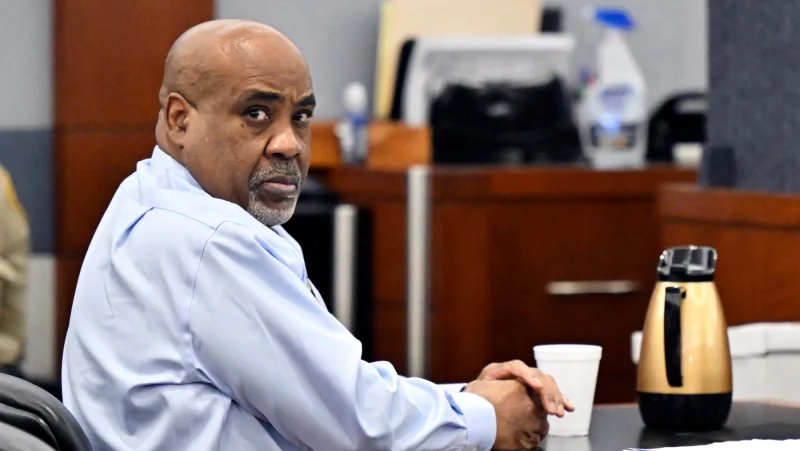
Jurors in Duane Davis’s murder trial heard a recorded police interview on Thursday in which he said Orlando Anderson fired the shots that killed Tupac Shakur in the 1996 drive-by shooting in Las Vegas. The recording, made on Dec. 18, 2008, put Davis’s own account of the night in front of the jury and tied Anderson directly to the gunfire.
The interview mattered because it was not a broad recollection of a long-ago night. It was Davis speaking to detectives at his lawyer’s office in Los Angeles County, after being told, “Nothing you say can be used against you.” Former LAPD Det. Greg Kading said Davis agreed to talk in hopes of avoiding prosecution on drug charges, and Davis made clear he was thinking about the end of the road. He told investigators he was “through with this shit,” then described the ride in a rented white Cadillac in detail.
Davis said he was in the front passenger seat, with Orlando “Baby Lane” Anderson directly behind him and DeAndre “Dre” Smith behind the driver, Terrence “Bubble Up” Brown. He said the BMW carrying Suge Knight and Tupac Shakur was idling at a red light at Flamingo Road and Koval Lane on Sept. 7, 1996, when he passed a loaded.40-caliber Glock to the back seat. Smith, he said, hesitated. Anderson then grabbed the weapon, leaned over the window, rolled it down and opened fire.
That sequence is what made the recording so damaging. Davis told detectives he had no clear shot, saying, “If they drove on my side, I would have popped ’em, know what I’m saying. But they was on the other side.” He also said he believed Knight had been shot in the head and would not survive. Then, after the shooting, he said the group returned to their hotel to smoke weed and drink, even as an ambulance carrying Shakur and Knight passed him and the others near a crosswalk on Las Vegas Boulevard.
There was another layer to why investigators were talking to Davis in the first place. Former LAPD Det. Daryn Dupree testified Wednesday that he and Kading approached Davis in the garage of his Inland Empire home in 2008 while investigating the 1997 Los Angeles murder of Christopher Wallace, also known as the Notorious B.I.G. and Biggie Smalls. Prosecutors have said the interview played Thursday was central to Davis’s murder trial and amounted to a full confession of his role in the shooting.
What the jury has now heard is not just an old police conversation but Davis’s own version of how Tupac Shakur was killed and who fired the shots. The remaining question is whether that recording, stripped of the distance of time, is enough to carry the case as far as prosecutors want it to go.