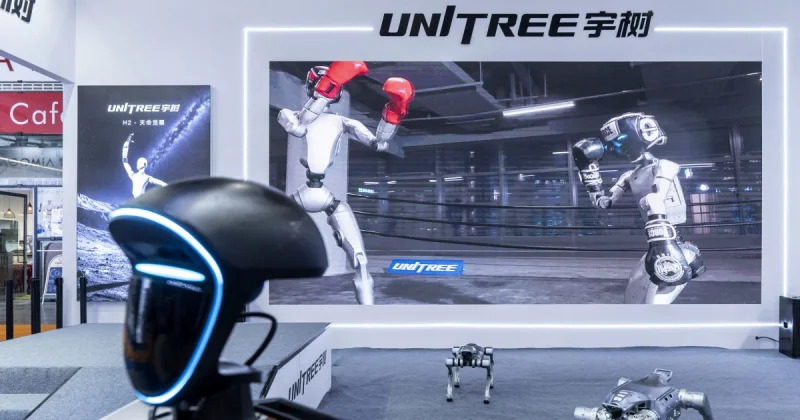
Unitree shares jumped more than 600% on Wednesday in their Shanghai trading debut, turning the humanoid robot maker into one of the hottest listings on the STAR market after it raised 6.1 billion yuan, or $905 million, in an oversubscribed IPO.
The debut matters because Unitree is not just another tech listing. It is the first humanoid robot maker to be listed in mainland China, and the scale of demand was extreme: the IPO was oversubscribed more than 8,000 times, setting a record for Shanghai’s tech-focused STAR market. For investors, that was the clearest sign yet that China’s push into AI and robotics still has real momentum.
Wang Xingxing founded Unitree in Hangzhou in 2016, and his company has become known for robots that dance, perform kung-fu and even backflips. Last year, its robots performed dancing choreography at China’s annual Lunar New Year gala, and Wang was seated in the front row at President Xi Jinping’s rare symposium with top tech businesses. That combination of spectacle and state attention has made Unitree one of the most closely watched names in China’s robot race.

Unitree also used the week before its listing to widen the spotlight. On Monday, it unveiled a humanoid robot called Superman and said the machine can jump as high as two metres and run at 12.66 metres per second. The company has framed its work as part of a broader push in embodied AI, the kind of software and hardware pairing that lets robots sense, move and act in the physical world rather than only respond on a screen.
Even so, the numbers behind the business show how early the market still is. Research and educational institution use accounted for the majority of Unitree’s sales in the first three quarters of 2025, while industrial deployments made up less than 10%. That gap helps explain why the company can command excitement in public markets while still facing a harder test in factories, where robots must work reliably, repeatedly and at scale.
Analysts say that is the tension beneath the debut. Ethan Qi called the IPO a key milestone for the humanoid industry and a benchmark for other offerings in the pipeline, while Kangyuxiao Li said Unitree has shown strong technology and commercial traction but that moving from demonstrations and early deployments to widespread industrial adoption will take time. Bipedal robots may be attracting attention now, but they are still years away from full-scale deployment.
Unitree said the IPO proceeds will go into research and development of embodied AI models and robot hardware, plus factory expansion. That points to the next phase of the story: converting a market frenzy built on demonstrations into a larger business built on machines that can actually leave the showroom and earn their keep in the real economy.