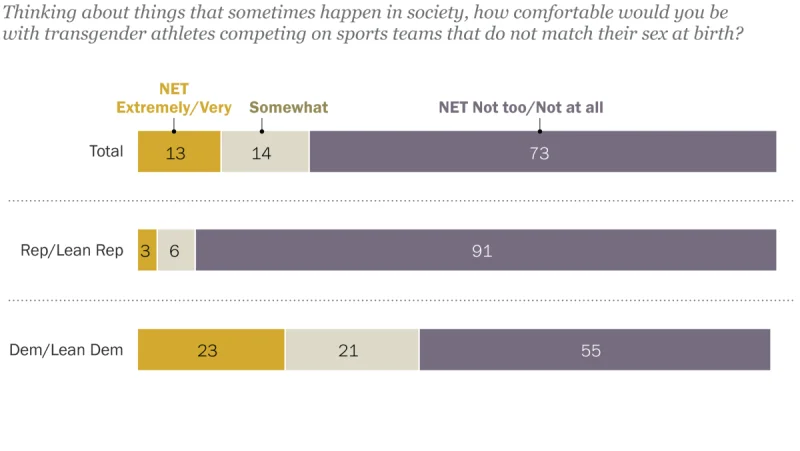
Pew Research Center found that most U.S. adults were uncomfortable with transgender athletes competing on teams that do not match their sex at birth, a stance that has only hardened as Bruce Jenner remains part of a debate now pulled further into view by the U.S. Supreme Court.
The timing matters because Pew surveyed 10,357 U.S. adults from Nov. 17 to 30, 2025, after the court ruled in June that states can restrict transgender women and girls from participating in women’s and girls’ sports. The survey lands in the middle of a larger public argument over who gets to compete, and under what rules, at a moment when the issue has moved from policy papers into the center of sports and politics.
Republicans were overwhelmingly opposed. Ninety-one percent said they would not be comfortable with transgender athletes playing on teams that do not match their birth sex. That view was even stronger among conservative Republicans, at 95%, and still held for 84% of moderate and liberal Republicans. In February, 88% of Republicans favored a law or policy requiring transgender athletes to compete on teams that match their sex at birth, up from 85% in 2022.
Democrats were more divided, but not nearly as split as the national debate can sound. A slim majority, 55%, said they would be not too or not at all comfortable with transgender athletes playing on teams that do not match their birth sex. Another 21% said they would be somewhat comfortable, while 23% said they would be extremely or very comfortable. Among liberal Democrats, 37% were extremely or very comfortable and 24% were somewhat comfortable, while 68% of conservative and moderate Democrats said they would be uncomfortable. Support for a law or policy requiring athletes to compete by sex at birth stood at 45% among Democrats in February, up from 37% in 2022.
That split sits beside another one. In February, 56% of adults supported policies aimed at protecting trans people from discrimination in jobs, housing and public spaces, while 16% opposed them. So even as many Americans were uneasy about transgender athletes in women’s and girls’ sports, a majority still backed broader protections for trans people in everyday life.
Pew’s numbers show a public that is not moving in one direction. On sports, discomfort dominates. On discrimination protections, support remains the majority view. What comes next is not a simple question of sentiment, but whether lawmakers and schools keep treating those two positions as separate issues or push them into the same fight.