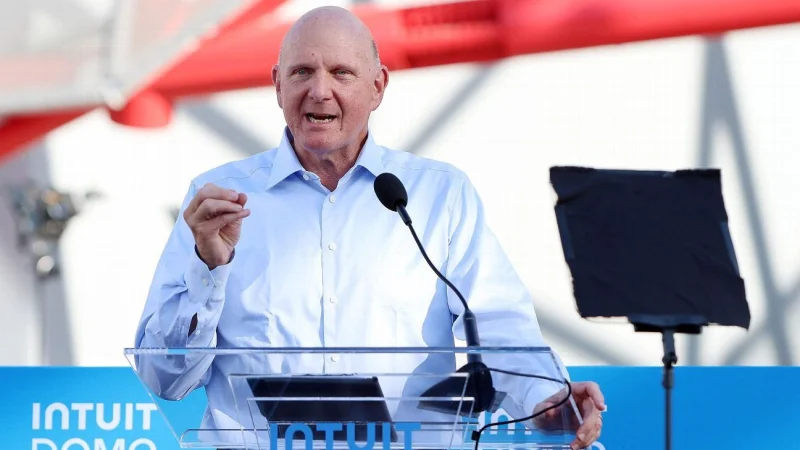
The NBA says it has found no evidence that Steve Ballmer funneled money through team sponsors to pay Kawhi Leonard, a finding that cuts against the central allegation in the league’s 11-month investigation. But the league is still pressing ahead on a narrower question: whether the LA Clippers crossed salary cap rules by introducing Leonard to companies tied to the team.
That matters now because the NBA has already shared initial findings with the Clippers and recent negotiations have centered on whether the matter can be resolved without a formal finding that the team violated league rules. Ballmer, who invested $50 million in Aspiration through his personal LLC in September 2021 and later added another $10 million on March 9, 2023, remains at the center of the case because the early reporting tied those investments to Leonard’s sponsorship deal.
The case began after a September 2025 report by Pablo Torre citing internal documents that linked Ballmer, Leonard and Aspiration, the now-defunct green banking company at the heart of the allegations. The Clippers signed a $300 million deal with Aspiration in September 2021, and Aspiration became the first founding partner of the Intuit Dome. A month later, Aspiration signed a $28 million endorsement deal with Leonard in April 2022, and an unnamed employee alleged that the sponsorship was “was to circumvent the salary cap,” while Torre described Leonard’s arrangement as a “no-show” job.
Since then, the league’s inquiry has widened beyond Aspiration to at least three other companies that had deals with the Clippers, including Daktronics and Boingo Wireless. It has also raised a separate question: whether the club failed to supervise employees if team personnel used sponsor introductions in a way that broke league rules against salary cap circumvention. If the NBA concludes the Clippers violated those rules, penalties could follow under the league’s salary cap enforcement system even without proof that Ballmer personally routed money to Leonard.
The Clippers have pushed back by saying they “introduced players, including Kawhi Leonard, to companies with which we had business relationships” and that making such introductions is an ordinary NBA practice and a common request from players and representatives. The team also said it did not “negotiate or dictate” Leonard’s endorsement terms and that “the fact that a player has an endorsement relationship with a company that also does business with his team is not evidence of salary-cap circumvention.”
David N. Kelley and Rick Buchanan have been leading recent negotiations over a possible resolution, but the NBA has not yet closed the case. The league’s finding that it lacks evidence of a Ballmer funneling scheme narrows the spotlight, but it leaves the harder question intact: whether the Clippers’ business relationships were used in a way the salary cap does not allow.