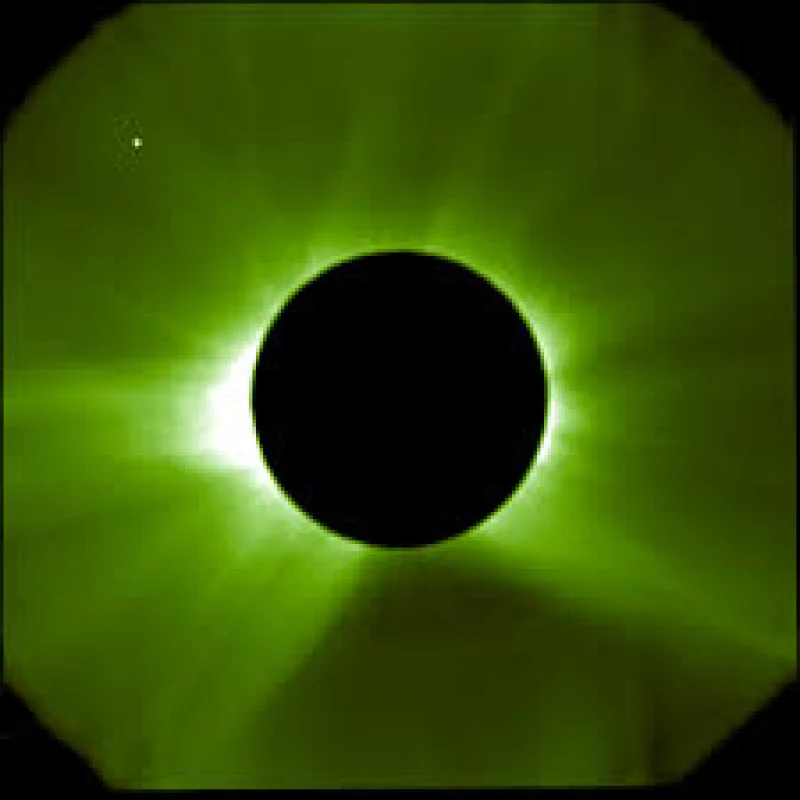
ESA has used its Proba-3 mission to make an artificial solar eclipse about two weeks before the 12 August 2026 total eclipse that will shadow parts of Europe. The image is meant to help scientists judge how the solar corona may look when the Moon blocks the Sun for observers in Greenland, Iceland, Spain and Portugal.
Andrei Zhukov said the frame was the 62nd eclipse of Proba-3's nominal operations, part of the mission when it captures coronal images. He said the spacecraft pair was designed to work as one, with the Occulter flying 150 metres ahead of the Coronagraph while ASPIICS records the scene.

The reason the timing matters is simple: totality will last for up to just over two minutes, but the corona is the region researchers need to study if they want to understand space weather. That is the part of the Sun tied to disruptions in satellite networks, communication infrastructure, power grids and other technologies, which is why eclipse observations keep drawing attention even though they are so brief.
Zhukov said the image was taken about two weeks before the natural eclipse on 12 August, and that the Sun takes two weeks to rotate halfway around its axis. By mirroring the image horizontally, he said, it can be used as a prediction of how the corona will appear from Earth two days later. He added that the large-scale coronal structure usually does not change much over that span, which is what makes the comparison useful.
That still leaves the same hard limit that has always shaped eclipse science: the real event is rare, happening around once a year and very rarely twice a year in different places, while the part scientists most want to see is visible only during totality. Proba-3 is meant to stretch that window from minutes to hours at a time, and the ESA-led Solar Orbiter mission is already running a special observation campaign in the days leading up to 12 August. Together, the two missions are turning the coming natural eclipse into a test of how much of the corona can be anticipated before the sky goes dark.