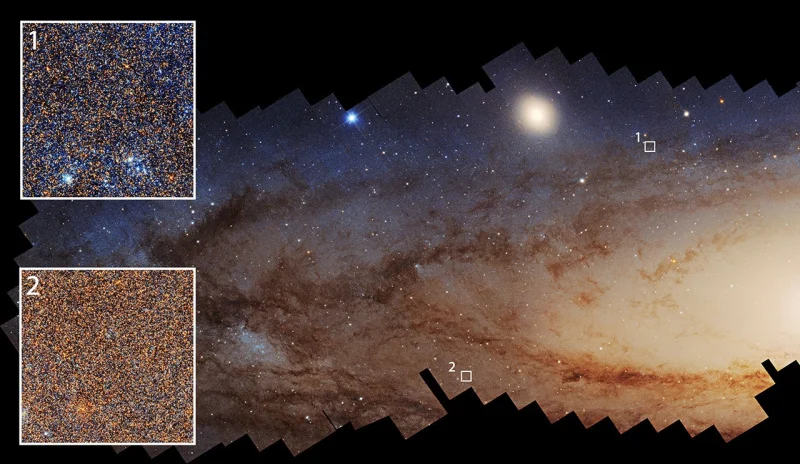
A new Hubble Telescope Andromeda M31 Study finds that star formation in Andromeda has been easing for 500 million years, and that the slowdown became sharper in the last 40 million years. The galaxy now forms stars at only about one-fifth the mass of our Sun per year, a far cry from the pace it once kept.
The result was published Monday in The Astrophysical Journal, giving astronomers a fresh measure of how one of the Milky Way’s closest large neighbors changes over time. Andromeda sits about 2.5 million light-years from Earth, close enough to be seen with the unaided eye from dark skies, and its size makes it a useful stand-in for studying how spiral galaxies age.
To reach that conclusion, the team combined two Hubble surveys — the Panchromatic Hubble Andromeda Treasury and the Panchromatic Hubble Andromeda Southern Treasury — and mapped two-thirds of Andromeda’s disk in ultra-sharp detail. They measured about 200 million individual stars, then used those stars as a record of the galaxy’s past. Ben Williams said that is why the work depends on individual stars: they act as the fossil record of how the galaxy formed, and Hubble is the only telescope that can deliver enough sharpness across such a large area in Andromeda.

The numbers tell a clear story. About 500 million years ago, Andromeda was forming stars at roughly one solar mass per year. By 40 million years ago, that had fallen to about half that level. The researchers also found that much of the recent activity was concentrated in a star-forming ring about 32,000 light-years from the galaxy’s center, and much of the decline came from fading activity in that same ring.
That is where the study gets interesting. The slowdown does not look like a simple shortage of raw material for new stars. Instead, it points to a galaxy that is winding down after a more active phase. Previous research had already shown that Andromeda went through a dramatic burst of star formation about 2 billion years ago, so the current decline fits a longer shift rather than a sudden failure. Tobin Wainer compared it to what happens after a marathon: sometimes a runner needs a breather.
The team also tested whether the drop was spread evenly across the galaxy or tied to certain regions, and they looked for a possible link to M32. What they found most strongly was a local slowdown inside the ring, which means the key question now is not whether Andromeda is still forming stars, but what physical process is quieting that activity so unevenly. The study sharpens the picture, but the mechanism behind the recent slowdown remains the part astronomers will now try to pin down.