


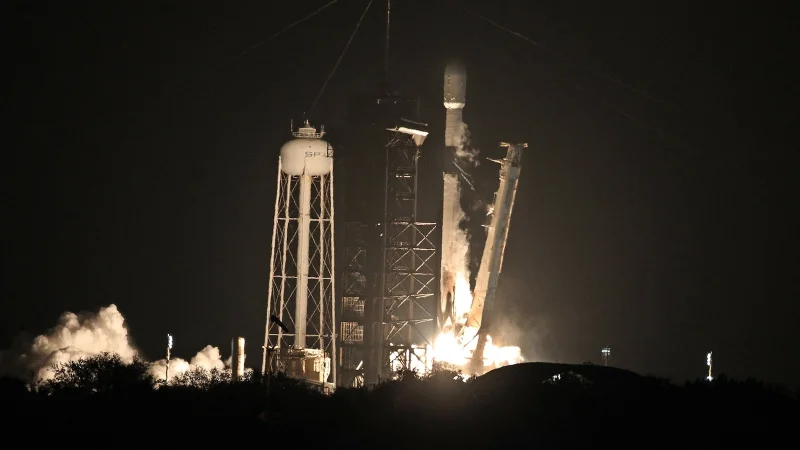
A discarded Falcon 9 upper stage is on course to strike the moon on Aug. 5 at around 2:34 a.m. ET, setting up a rare crash that researchers say can be watched, measured and learned from in real time. The object is moving at 5,400 miles per hour and is expected to hit near the crater Einstein on the western lunar limb.
Bill Gray was the first to calculate that the rocket would hit the moon, and he has kept tracking it ever since. Gray, who runs Project Pluto and develops software for tracking astronomical objects, later co-authored a study with an international team of researchers that was made available on arXiv, though it has not been peer-reviewed.
The event has drawn attention because it gives scientists a known-mass, known-speed impact they do not usually get. Benjamin Fernando, a postdoctoral researcher at Los Alamos National Laboratory in New Mexico and the study’s lead author, said the collision should vaporize the booster, flash brightly and throw up a plume of ejecta before cutting a fresh crater into the lunar surface.

That is why the impact matters beyond the moon itself. Fernando said the plume could help researchers sample material from that part of the moon, and that a collision like this can serve as a calibration event for techniques normally used to study natural impacts that cannot be predicted in advance. He said it also offers a way to think about direct risks, such as debris or a flash of light, and indirect risks from a cloud of ejecta affecting spacecraft functions in lunar orbit.
The twist is that the upper stage was not supposed to end up on a collision course with the moon. On Jan. 15, 2025, SpaceX launched the Falcon 9 carrying Firefly Aerospace’s Blue Ghost 1 lander and ispace’s Resilience lander toward the lunar surface, and during that mission the booster was abandoned in a moon-crossing high-Earth orbit. Blue Ghost landed on March 2, 2025, while Resilience crashed after communications were lost 90 seconds before landing.
For now, the next milestone is simple: if the calculations hold, the moon gets hit in the early hours of Aug. 5. The larger question is what the impact reveals about lunar material and how prepared future missions will be when NASA is aiming to return astronauts as early as 2028 and eventually build a permanent moon base.
