


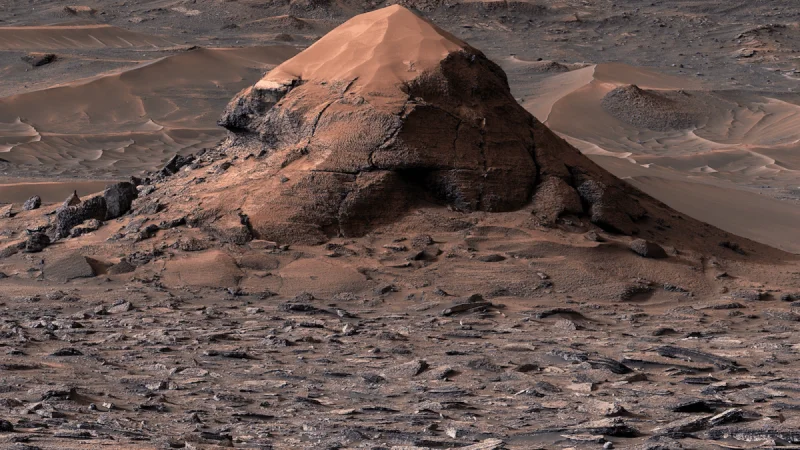
NASA’s Curiosity rover has found a broad field of honeycomb-like fractures in Valle Grande while climbing a Martian valley, and the patterns stretch as far as the rover can see. The panorama, taken on June 19 and 20, shows polygons that wrap around a nearby butte and mark one of the most striking textured landscapes Curiosity has sent back from Mars.
The images were taken on Curiosity’s 4,930th and 4,931st Martian sols, and the fractures are each about 1.5 to 3 inches across. Ashwin Vasavada said the field took the team’s breath away and that the shapes and chemistry were measured carefully, a sign that scientists think the scene may hold clues to how the surface formed.

That matters because Curiosity has been climbing Mount Sharp since 2014 and has spent 14 years on Mars turning up evidence that ancient Mars once had water, chemistry, and nutrients that could support microbial life. The rover has also uncovered carbon-based molecules thought to be precursors to RNA and DNA, though scientists still do not know whether those organic molecules came from biologic or geologic processes.
What makes Valle Grande different is scale. Scientists have seen polygonal shapes before, including patches that clearly formed as mud cracks, and warm and cold temperature cycles or the squeezing of water out of buried sediment can produce similar textures. But the new field is larger than earlier patches the mission has photographed, and the polygons spread in every direction around Miraflores, a 20-foot butte capped with sand.
That leaves the main question unresolved: whether the Valle Grande polygons came from mud cracking alone or from one of several processes that can make the same honeycomb look. Curiosity has measured the shapes and chemistry, and that work now has to sort a landscape that looks simple at a glance but may record a more complicated history beneath the Martian surface.
