


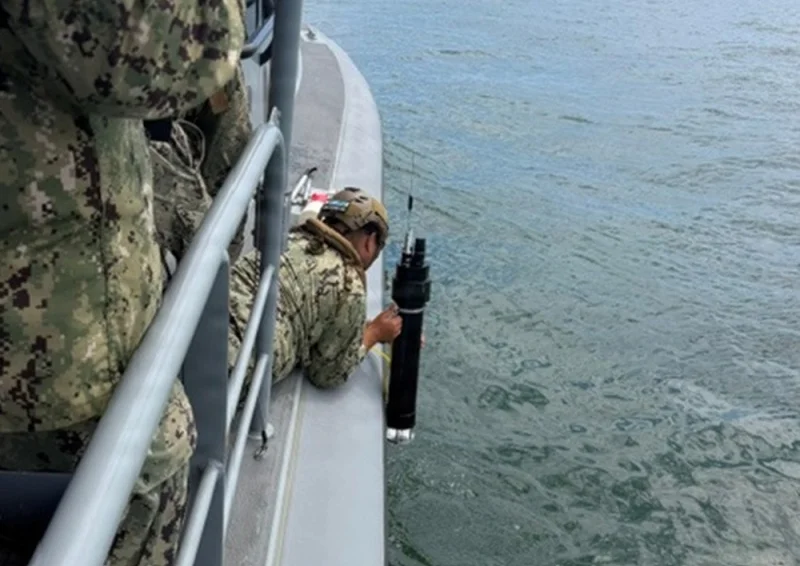
The U.S. Army has tested the maritime version of Hammer of the Gods at sea off the U.S. West Coast for the first time, giving its counter-PNT system an official debut in a setting where precision weapons depend on fragile signals. The exercise took place in mid-July as part of Project Convergence Capstone 6.
That matters because the system is designed to covertly scramble positioning, navigation and timing signals, including GPS data, used by enemy precision weapons. Without reliable PNT data, long-range artillery, guided missiles and cruise missiles are less accurate, more likely to miss and more likely to be delayed. The Army said the test also showed the maritime variant could be launched, operated and recovered in a real-world naval environment.

The timing explains why the test is getting attention now. On Sunday, the Army revealed the overseas trial and described it as the maritime variant's official debut, after land-based versions had been demonstrated over the past two years. This was not a lab exercise or a static display. It was a joint test involving the U.S. Army, U.S. Navy and U.S. Space Force, along with U.S. Space Forces Pacific, Naval Base San Diego and the U.S. Army Space and Missile Defense Command.
What makes the system different at sea is not the basic function but the way it has to work. On land, a portable disruptor can be positioned to jam enemy navigation signals and help create a resilient communications network for friendly forces so troops can keep shooting, moving and communicating in degraded environments. At sea, the same mission has to be launched, recovered and kept effective on a moving platform while still denying enemy weapons the positioning data they need. That is a harder problem, and the Army has now shown only that the maritime version can be run successfully once, not that it has been proven repeatedly.
The broader strategic backdrop came from French Adm. Pierre Vandier, who said Ukraine has exposed an arsenal that cannot be produced at the scale now required and added that there is no way to produce 50,000 Patriots a year. His point was about industrial limits, but it also underlines why militaries are looking for systems like Hammer of the Gods: tools that can reduce the value of precision weapons without waiting for a production surge that may never come. The next question is not whether the Army can move the system onto a ship. It is whether this first overseas maritime trial becomes the start of a repeatable capability or remains a one-off demonstration.
