


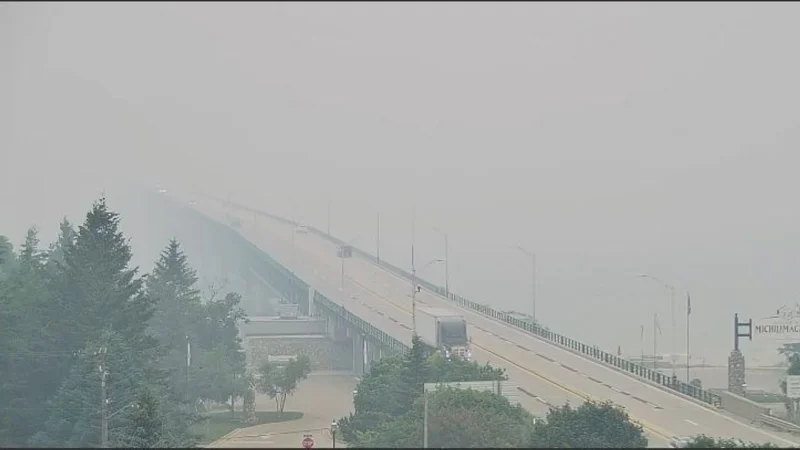
Michigan Republicans in Congress sent a new letter on 2026-07-15 to Canada's Prime Minister, demanding action on wildfire smoke that has drifted into Michigan and the northern Midwest. The message from Jack Bergman, John James, Lisa McClain and John Moolenaar says the problem has gone on long enough and that American families are still paying the price.
The timing matters because the smoke has been a recurring public health and quality-of-life problem across the region, and the lawmakers are now trying to force a concrete answer instead of another round of assurances. Bergman said he has spoken with United States Ambassador to Canada Peter Hoekstra and members of the Canadian government, but said those discussions have not produced meaningful progress.
The letter makes the demand unusually direct. The representatives said they were asking for specifics, not sentiment, and wanted to know what funded, measurable steps Canada's government has taken since last summer to reduce fuel loads and wildfire risk in the provinces responsible for the smoke reaching the American Midwest. They also asked what accountability exists for provincial leaders and what would be different by this time next year.

That push lands against a government that has already laid out its fire management policies. The lawmakers say those plans have not been enough. They said they had repeated conversations with Canadian officials and had already sent a previous letter, yet still saw a lack of meaningful progress. In their view, continued inaction from Canada is unacceptable, especially after years in which they say the underlying causes of worsening wildfires were left unaddressed.
The friction is not just over what Canada should do, but over who should bear the burden if it does not. The letter says the United States could explore direct involvement in cross-border fuel reduction and firefighting capacity, a notable signal that the delegation is willing to widen the response beyond protest. Bergman said Canada must live up to the responsibility that comes with sovereignty and warned that if it will not manage its forests to prevent the fires, the United States will look elsewhere and act on its own to protect its people.
Huizenga echoed that view and said Canada's inability to mitigate, contain and prevent its wildfires must be addressed. He said he has also spoken with Hoekstra and with members of the Canadian government, and called on the Canadian Government to fully and regularly inform appropriate U.S. agencies such as the EPA about the status and mitigation action plan regarding the fires. The Canadian Foreign Ministry had not yet responded to a request seeking comment and more information. For now, the unanswered question is whether Canada's next move will be a new, funded plan that the lawmakers can measure, or another season of smoke and another year of blame.
