


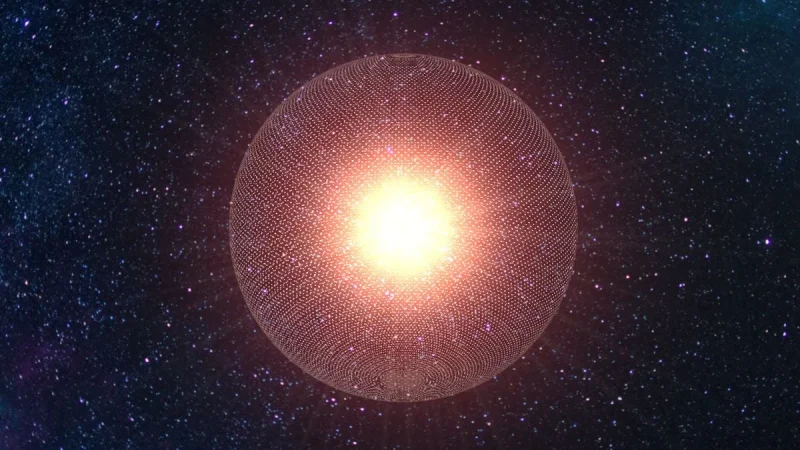
Researchers led by National Tsing Hua University in Taiwan have put a black hole at the center of a Dyson sphere question once reserved for stars: could an advanced civilization wrap one in collectors, and could telescopes spot the waste heat? The answer, in the team’s analysis, is that the idea is not just imaginable but measurable.
The study examined six possible energy sources, from the cosmic microwave background to Hawking radiation, accretion disk power, Bondi accretion, a hot corona and relativistic jets. That matters now because the work turns a speculative megastructure into an observational target, one that current telescopes might already be able to test by looking for the infrared glow of unused energy.
At the simplest end, the cosmic microwave background is just leftover radiation from the early universe, and a black hole could act as a cold sink while a surrounding structure gathered that energy. But the payoff would be tiny: the available power would be far too low for a Type II civilization, the kind of society associated with roughly 10 to the 26 watts of energy use. The same study found that Hawking radiation, the faint theoretical emission tied to quantum effects near an event horizon, would be even less useful. For a black hole with five times the Sun’s mass, the output would be about 10 to the minus 30 watts.

The more serious candidates were the hotter, brighter ones. Matter falling toward a black hole can form an accretion disk, and intense heating there can produce large amounts of radiation. Even a stellar-mass black hole operating at a low Eddington ratio could emit hundreds of times the Sun’s luminosity. The researchers used an accretion efficiency of 5.7 percent for a nonrotating Schwarzschild black hole and 39.9 percent for an extreme rotating Kerr black hole, and at the same accretion rate the Kerr disk could be seven times brighter. They also estimated that a corona, the extremely hot plasma around the inner disk, could raise useful radiative output by 30 to 50 percent beyond the disk alone.
Relativistic jets pushed the numbers higher still. These narrow plasma flows carry radiation and kinetic energy, and the team estimated their radiation could equal 60 to 80 percent of the disk’s luminosity, with total jet power about 10 times its radiative output. For a five-solar-mass black hole with a low Eddington ratio, they calculated total jet energy of about 1.7 million solar luminosities. Around a supermassive black hole similar in mass to Sagittarius A*, combining disk, corona and jet power could lift a civilization’s Kardashev index to 3, a level associated with galaxy-scale energy use.
That promise comes with a hard constraint. A complete shell around an energy source is mechanically unstable, so the researchers instead considered swarms, rings, bubbles and light sails. Any structure meant to absorb disk radiation would also have to sit beyond the disk itself, and the likely range for a hot system was between 1,000 and 100,000 Schwarzschild radii, depending on temperature, luminosity and black hole mass. That leaves the central question unresolved: the energy may be there, but whether a real civilization could build such a system is still an open engineering problem.
What the analysis does deliver is a new search strategy. Instead of treating black holes only as obstacles or curiosities, it casts them as possible power plants for hypothetical Dyson Spheres and says the waste heat from such collectors could be the thing astronomers look for next.
