


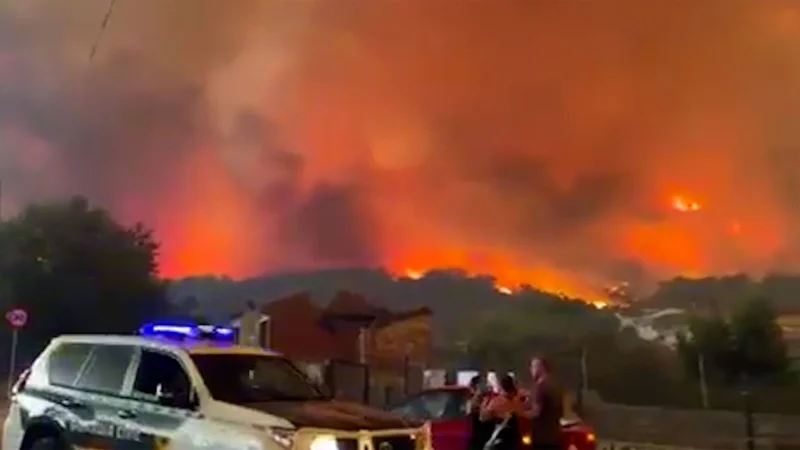
More than 60,000 people were evacuated or confined on Saturday as two major wildfires in the southwest of the Comunidad de Madrid and in Ávila stayed out of control, keeping the emergency open across a wide stretch of the Sierra and turning the next hours into the key test for the response.
Pedro Sánchez arrived at the Puesto de Mando Avanzado in Cenicientos after 9:45 a.m. to join the coordination meeting on a day when the scale of the damage was already clear: Chapinería, Navas del Rey, Colmenar del Arroyo, Fresnedillas de la Oliva, Robledo de Chavela, Navalagamella, Valdemaqueda, Aldea del Fresno, Zarzalejo and Peralejo remained evacuated, while San Martín de Valdeiglesias, Pelayos de la Presa and Villa del Prado stayed under confinement. Traffic on the M-501, M-507, M-512 and M-533 was limited to emergency services, a sign that the fire line was still dictating movement as much as the authorities were. Sánchez had been due to visit the affected area and attend the Cecod meeting on Saturday, after Friday's national emergency declaration for the exceptional gravity of the fires in Madrid, Ávila, Toledo, León and Huelva.

The numbers show how broad the emergency had become before the political visit ever started. Huelva had already been stabilized, but the fires in Ávila and the southwest of the Comunidad de Madrid were still active and uncontrolled. The Guardia Civil had evacuated more than 90 employees of the Complejo de Comunicaciones del Espacio Profundo de la NASA on Friday afternoon, underlining how quickly the flames reached beyond homes and into infrastructure that could not simply be shut down and left to burn.
That urgency sat uneasily beside what crews said had happened overnight. At 7 a.m. on Saturday, the Comunidad de Madrid said extinction teams had worked intensively in the Sierra Oeste fire to take advantage of favorable night weather conditions, and that they had worked without rest while taking advantage of slightly more favorable weather. Even so, the fires did not merge during the night, a brief break in the worst-case scenario that did not change the central fact: the blaze remained active. The regional government said its evolution would be determined by the wind regime in the next hours, with temperature and humidity also shaping what came next.
For now, the emergency is being measured less by statements than by containment lines that have not yet held. The overnight work bought time, not control, and that leaves the coming hours as the point where the fire either begins to ease or forces another round of evacuations and restrictions across the Sierra Oeste.
