


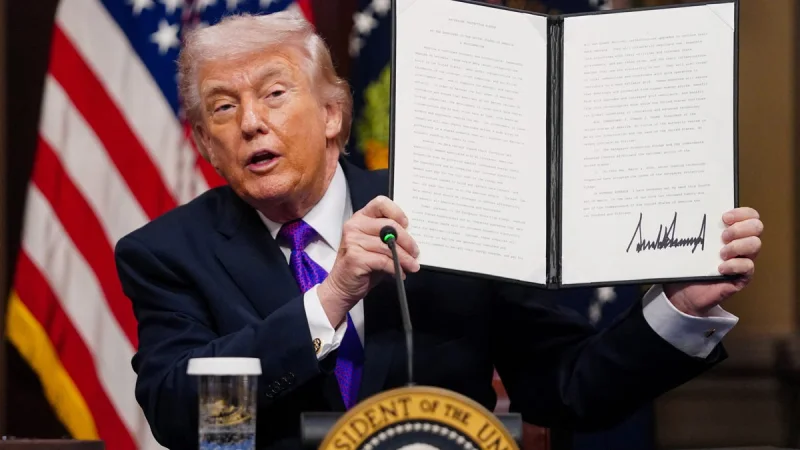
President Donald Trump is set to announce on July 23 that 23 Republican governors have signed his Ratepayer Protection Pledge, a move that widens a campaign that began with companies and now reaches into state government. He is expected to make the announcement at an event at the Environmental Protection Agency headquarters, where four governors are scheduled to attend.
The pledge is aimed at keeping households from being stuck with utility costs tied to data centers. Companies that sign agree to protect American consumers from price hikes linked to data center energy and infrastructure needs and to help lower electricity costs over time. Trump’s team says the coalition now includes nearly 200 stakeholders, and the governor signers include Kay Ivey, Brian Kemp, Kim Reynolds, Mike DeWine, Greg Abbott, Bill Lee and Spencer Cox.
The push lands as electricity costs are up about 4% from last year and energy costs have climbed 16%, keeping pressure on families already facing higher bills. The pledge was first put forward by the White House in March, when seven tech companies — Google, Microsoft, Meta, Oracle, xAI, OpenAI and Amazon — signed on. Since then, the effort has grown beyond the private sector and into a message about who should pay when data centers need more power, more infrastructure and more of the grid.

That is also where the clean message gets messy. The pledge is non-binding, yet the addendum for governors asks them to implement its principles to the greatest extent possible in their positions. In practice, that leaves the document dependent on how far each state is willing to go, even as Trump presents it as a broad commitment to stop data center costs from landing on American families.
Brian Kemp is among the governors expected at the Environmental Protection Agency headquarters, along with Jeff Landry, Jim Pillen and Brad Little. No Democrats signed the document, and three of the nation's 26 Republican governors have not signed: Phil Scott, Kelly Ayotte and Ron DeSantis. DeSantis signed a new state law this year that imposed strict regulations on data centers, underscoring that the politics around the issue do not run in one direction.
Trump’s July 23 announcement will show how far the pledge has spread, but it does not settle the harder question underneath it: whether a voluntary promise can actually change who pays for the next wave of data centers. That answer will depend less on the ceremony than on what governors and companies do after the cameras leave.
