


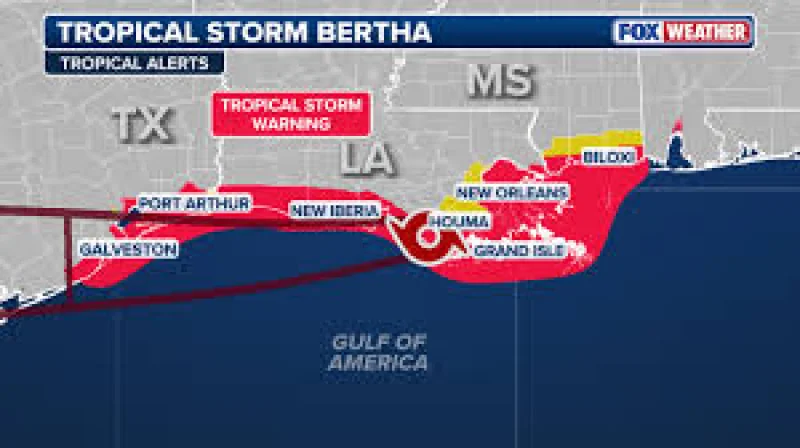
The National Hurricane Center expanded Tropical Storm Warnings westward late Wednesday night as Tropical Storm Bertha moved toward the Louisiana coast and a new warning was issued from Cameron, Louisiana, to Sargent, Texas. As of the 11 p.m. ET advisory, Bertha was about 75 miles southwest of New Orleans and 135 miles east-southeast of Lake Charles, Louisiana.
That update mattered because the storm was still strengthening its footprint across the Gulf Coast even as it pushed west at 12 mph with maximum sustained winds of 45 mph and a minimum central pressure of 1002 mb. The agency expected Bertha to continue tracking westward near or along the Louisiana coast overnight before approaching the upper Texas coast on Thursday, making the warning change immediately relevant for people in its path.
The new warning also clarified where the danger was shifting. The National Hurricane Center discontinued the Tropical Storm Watch for Lake Maurepas and ended the Tropical Storm Warning east of the Alabama/Mississippi border, signaling that the center of the storm and its strongest impacts were moving away from the eastern Gulf Coast and toward Louisiana and Texas.

Even so, Bertha was still leaving damage far from where it was headed. In Florida, storm surge washed out several sea turtle nests, and the Alligator Point Sea Turtle Patrol said all seven of its nests were either inundated or completely washed out. The group said, in effect, that it had not seen Bertha coming and was glad to see it go. Farther west, the Destin-Fort Walton Beach Sea Turtle Patrol said only four of its 22 nests survived, and a Waffle House sign crashed into a parking lot in Panama City.
That split between the storm's track and its impacts is what made this Bertha update more than a routine forecast note. A tropical system can send surge, rain and damage well away from its center, which is why Florida saw beach and wildlife losses even as the storm was being measured southwest of New Orleans and forecast toward Texas. Sea turtle nests can survive being washed over, but once floodwater fills the nest chamber, the eggs suffocate.
By Thursday, the key question was no longer whether Bertha would keep moving west. It was how much more of the Gulf Coast would have to absorb before the storm finally slipped onshore in Louisiana and then toward the upper Texas coast.
