


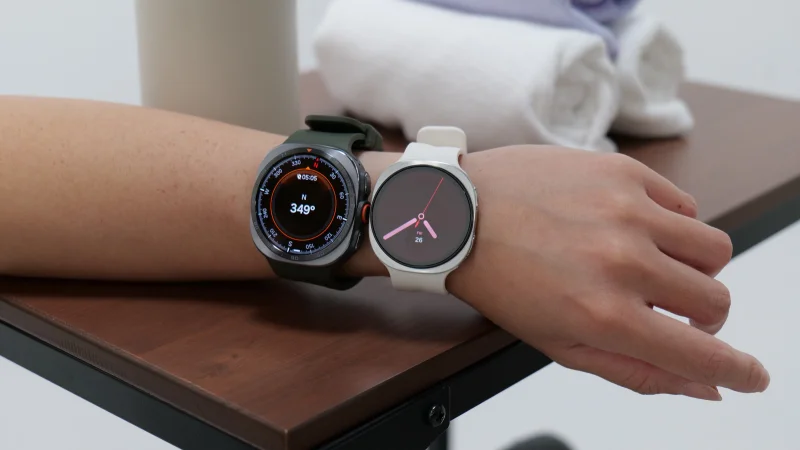
Samsung announced the Galaxy Watch 9 and Galaxy Watch Ultra 2 today, and the pitch is simple: more battery, more brightness, more AI, and more money. The Galaxy Watch Ultra 2 now costs $699.99, up $50, while the Galaxy Watch 9 is priced at $379.99, a $30 increase.
The timing matters because buyers of the Galaxy Watch are being asked to pay more for what Samsung presents as a refinement year rather than a full reset. The Galaxy Watch Ultra 2 gets an 800mAh battery, up 35 percent from the 590mAh cell in the original Ultra, while the Galaxy Watch 9 is mostly unchanged from the Galaxy Watch 8, apart from the new chip and a 3,000-nit display.
That chip is Qualcomm Snapdragon Wear Elite, replacing Samsung’s Exynos silicon in both watches. Qualcomm introduced Snapdragon Wear Elite earlier this year at Mobile World Congress as an AI-wearable first chip, and Samsung appears to be using it to improve Gemini performance and power efficiency at the same time. On the Ultra model, the payoff is not just longer life on paper. Samsung also says the case is 10.7mm thick, 12 percent thinner than before, with a 1.9mm strap that is about 1mm thinner, all while the display reaches 5,000 nits.
The new hardware is paired with features aimed squarely at outdoor use. The Galaxy Watch Ultra 2 adds trail run tracking that lets users download GPX files for GPS routes, then follow real-time navigation and elevation guidance. It also shows an estimated completion time and hydration alerts based on an algorithm that predicts sweat loss from workout intensity and demographic data. Samsung says the sensors do not directly measure electrolytes or water lost, which leaves the feature dependent on estimates rather than direct readings.
The Ultra model also carries IP69K, 10 ATM and EN 13319 resistance ratings, and Samsung says a bespoke diving app from Mares will arrive later this year. That app is supposed to monitor descent speed, record time at a given depth and give ascent guidance. A Wear OS update is also expected later, which could add more software polish to a launch built around incremental hardware gains rather than a dramatic redesign.
For Samsung, this is a year of refinement. The company is leaning on battery life and preventive health features, while the Galaxy Watch Ultra 2 pushes harder into brighter displays and outdoor tracking. For buyers, the trade-off is straightforward: the watches are better equipped, but they are also more expensive, and the real test now is whether the larger battery and new chip are enough to make the price increase feel justified once the watches are on wrists all day.
