


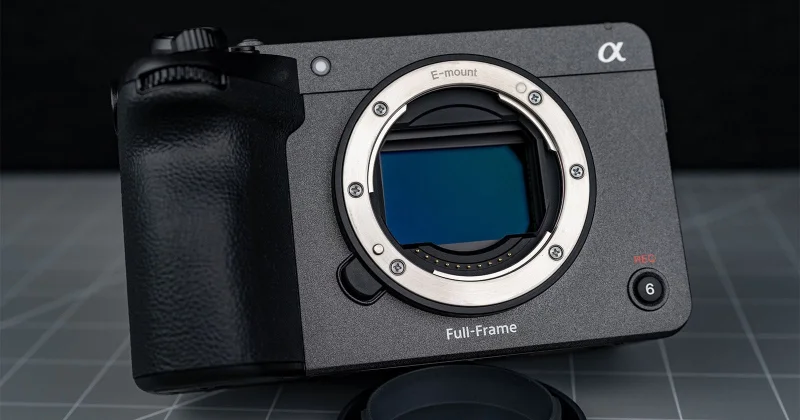
Sony launched the Sony FX5 with a new 16.6-megapixel fully stacked full-frame Exmor RS sensor, and that alone changes the shape of the FX Series. The camera folds in the compact, lightweight body style of the FX3 with some of the feature set and performance of the FX6, while adding Open Gate recording and internal X-OCN RAW for the first time in the line.
That is why the Sony FX5 is drawing attention now. It is not just another refresh. It brings a higher-resolution sensor than the 12-megapixel chips in the FX3 and FX6, which means it can push 5K recording, and it also uses the Bionz XR2 processor that debuted in the a7 V late last year. Sony paired that with a dedicated AI processing unit, aiming for better autofocus and more reliable subject tracking.
The new sensor choice is the part that will matter in the field. In hands-on first impressions, Jordan Drake pointed to the megapixel coincidence at the center of the design, and that detail helps explain why the FX5 can do things the earlier cameras could not. Sony says the camera records 4.5Kp120 and 5Kp60 for the first time in the FX family, adds false color, waveform and vector scope monitoring, and includes anamorphic desqueeze. For crews that want a smaller body without giving up higher-end output, that is a meaningful jump.

The trade-off sits inside the spec sheet. Sony says the FX5 can deliver up to 16 stops of dynamic range with Dual Gain, but that mode comes with a readout speed penalty. In practice, that means the camera’s best shadow and highlight performance is not free; it asks the sensor to work a little slower. The three base ISO settings of 800, 4000 and 12800 are meant to give cleaner shadows, wider exposure latitude and better clarity than prior dual base ISO cameras, depending on the light.
X-OCN is the other big step, and Sony is treating it as a serious internal RAW format rather than a checkbox feature. The company says the file type stands for Extended tonal range Original Camera Negative and offers 16-bit linear RAW recording with 280 trillion colors, or 1,000 times more color data than a 12-bit RAW file. That is also why the camera requires VPG400-validated cards for guaranteed performance: internal X-OCN needs sustained card speed, not just peak speed on a spec sheet.
What Sony has not given yet is the piece buyers usually want next, the date they can actually get one. For now, the FX5 reads like a camera built to answer requests the FX Series has carried for years: a smaller body, a more capable sensor, Open Gate, internal RAW and more recording options in one package. If Sony can deliver it cleanly, the FX5 will not just sit between the FX3 and FX6. It will pull the line in a new direction.
