


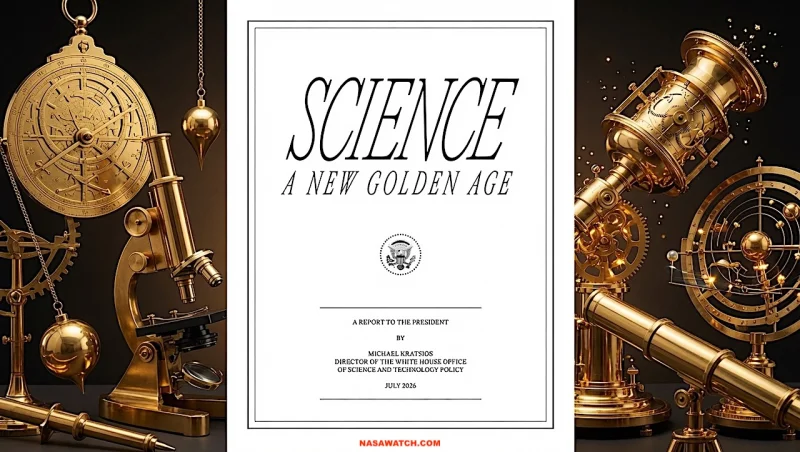
The OSTP pushed out a new plan late Tuesday that would remake how Trump administration AI research funding is handed out, with the federal research system told to put individual scientists ahead of legacy institutions. The report, Science A New Golden Age, says agencies should move faster, back a wider range of performers and build science policy around the AI era instead of the old academic map.
The report appeared online around 7:00 pm EDT on Tuesday, just before a House Science Committee hearing on Wednesday featuring OSTP Director Kratsios. Keith Cowing, writing on NASAWatch.com, said the report landed while the Administration was “gutting science,” a sharp line that captures the split between the report’s language and the politics around it. On one side is a call for a new Golden age; on the other is a warning that the machinery meant to support it has been undercut.
What makes the document more than a slogan is how concrete it gets about money. It says federal funding agencies should support a broader range of performers, including a new generation of mission-driven research organizations, and should organize research around interdisciplinary frontiers rather than the academic silos of the last century. It also calls for more flexible grants, including fasttrack grants and long-horizon grants, plus new ways for reviewers to champion radically unconventional ideas.

The report goes further still. It says agencies should judge themselves as capital allocators, test new ways of making grants and build portfolios with the intentionality of a serious investor. In plain terms, that means the government should stop acting like a passive distributor of money and start steering research dollars with more deliberate purpose toward national goals. The document says the federal government should set clear scientific goals, build the industrial muscle to translate discovery into technological strength and reunite discovery and manufacturing across the country.
That approach leaves an obvious question hanging over the system: which research programs and institutions would lose ground if legacy structures are no longer the default. The report does not name winners and losers, but its logic points away from institutions built to fit the last century and toward performers that can move quickly, cross disciplines and deliver results tied to national challenges. It is a redesign of the federal research pipeline, not a tweak at the margins.
The other force pushing the shift is AI. The report says the research enterprise must be prepared for the AI revolution, that AI will accelerate and radically transform the way science is done and that even capable models will be slowed by systems built for another era. It also says the infrastructure powering American science must be reengineered for the AI age, while still relying on human hands for instruments, prototypes, advanced manufacturing and the skilled trades. That makes the central argument hard to miss: if AI is changing how science works, the funding system has to change with it, and quickly.
Kratsios is now set to face questions at Wednesday’s House Science Committee hearing, where the report’s ambitions will meet the practical problem of money. The document sketches a full reordering of federal research funding, but it does not say how much would be shifted or how fast agencies would be forced to move. That is the gap worth watching now: whether the plan becomes a blueprint for a leaner, AI-ready science system, or stays a broad promise while the old one keeps running.
