


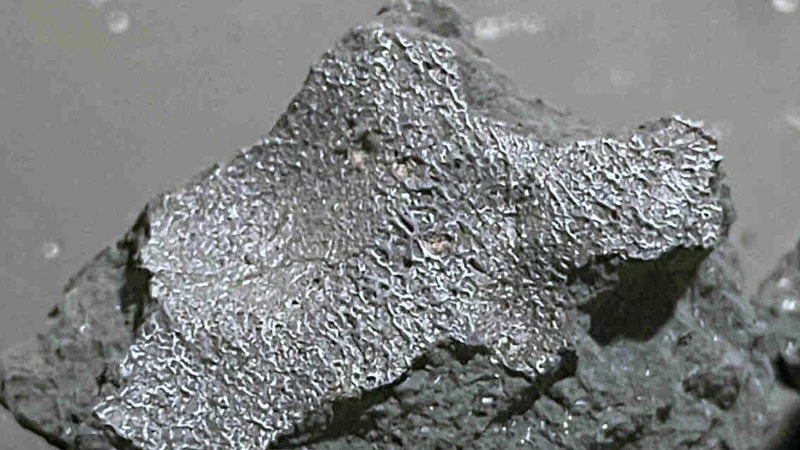
A meteorite that smashed into a home in Hillsborough, New Jersey, on July 16, 2024, has been identified as a rare CM1/2 carbonaceous chondrite with amino acids and other prebiotic molecules inside it. Scientists now say the rock, called Hillsborough, is one of the most scientifically valuable meteorites ever recovered.
The timing matters because a paper on the meteorite was published in Science Advances on Wednesday, turning an odd household disaster into a fresh look at some of the oldest chemistry in the solar system. Researchers at the SETI Institute said the object shook the New York City area with a sonic boom before it struck the house, moving at about 32,000 mph.
Inside the home, the homeowner heard the crash and found a hole in the ceiling of the master bedroom. The room was left with black fragments, debris and dust, and the meteorite carried a strong sulfur-like odor. The homeowner then did something that may have preserved the most useful part of the story: the rock was gathered with disposable gloves, wrapped in aluminum foil and stored in glass jars.

Mike Zolensky said that thanks to the homeowner's quick reaction, these are the most pristine CM1/2 meteorites scientists know of. Peter Jenniskens said forensic study of the fragments showed they preserved bits of a small, primitive asteroid that had once been soaked in concentrated salty fluids. Scientists said the sample contains a diverse suite of carbon-bearing compounds, amino acids and other prebiotic molecules, but they did not specify exactly which ones in the published details.
That is what makes Hillsborough unusual. It arrived like a break-in, tore through the roof, shattered into pieces and scattered across a bedroom, yet it is being treated as a rare chemical time capsule. Mike Hankey said the path traced back to low in the asteroid belt, while observers in New York, New Jersey, Connecticut, Rhode Island and Pennsylvania reported seeing the meteor to the American Meteor Society. Cameras in Northford, Connecticut, Douglassville, Pennsylvania and Wayne, New Jersey also caught it, and Doppler weather radar at Newark Liberty International Airport detected a long cloud of pebbles falling from Staten Island to New Jersey.
For scientists, the next step is not mystery but detail: squeezing as much history as possible from a rock that was almost ruined by the very event that made it valuable. The unanswered question is narrower now, and more interesting — exactly which organic compounds survived the trip down and what they can still say about the early chemistry of a primitive asteroid.
