


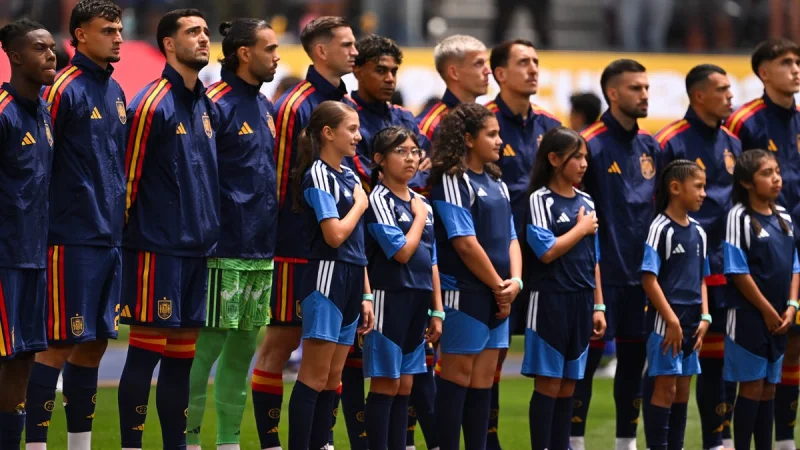
Spain’s national anthem will sound before Tuesday’s 2026 World Cup semifinal against France, and nobody will sing along. The tune known as the Marcha Real has no official words, so players and supporters will hear it as a melody, not a chorus.
That detail matters today because Spain is about to face France in one of the tournament’s biggest matches, and the anthem will again draw attention for what it lacks. The Marcha Real first appeared in 1761 in a book of Military Marches of the Spanish Infantry, was declared a March of Honor by Charles III in 1770 and was adapted by Bartolomé Pérez Casas in 1908 into the version that has survived to this day.

Efforts to give the anthem lyrics have been tried more than once. General Prim prompted a contest in 1870, Spanish officials opened it to musicians and poets, and no winner emerged. More than a century later, the Spanish Olympic Committee tried again in 2007, commissioning Paulino Cubero of Ciudad Real to write a text for Plácido Domingo to sing. Domingo rehearsed the words, but the lyrics never made it as far as Spain’s Congress for approval.
That failed attempt showed the central problem that has followed the anthem for years: once words were put on the table, disagreement followed. Vocal groups from around Spain were set against the 2007 version, and the opposition was strong enough that the project collapsed before a formal political decision could even be taken. The result is a national tune that remains easy to play and hard to settle.
Spain is not alone in having a lyricless anthem. Bosnia Herzegovina, San Marino and Kosovo also use national anthems without words, but Spain’s case stands out because repeated efforts have failed to produce a version that can win broad acceptance. For Tuesday, the answer is plain: Spain’s anthem will be heard, not sung, and the old search for lyrics remains exactly where it was left.
