


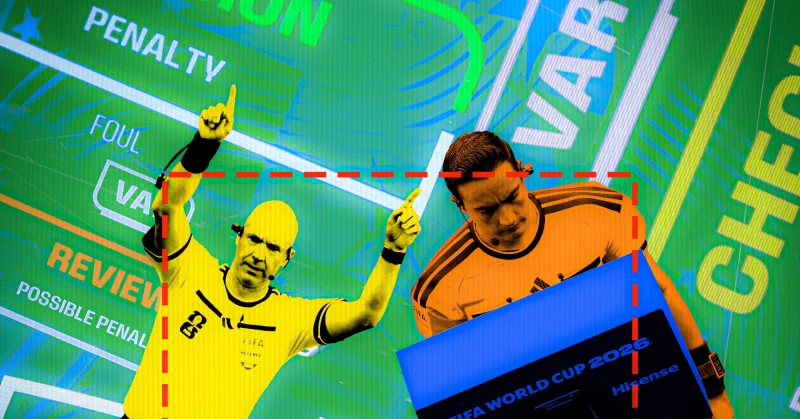
FIFA used VAR far more often than many expected at the World Cup, with well over 100 calls overturned throughout the tournament as the system reached deep into the flow of matches. What was sold as a tool for correcting only clear and obvious errors often became a stop-start exercise measured in minutes, not seconds.
That is why the search for how often is the World Cup being reviewed now lands on Sunday, when the tournament wraps up at the Meadowlands. The timing matters because FIFA did not just use VAR this summer; it ramped up its use significantly, turning the global event into the biggest test yet of whether replay can help without taking over.
The number of reviews tells part of the story. The bigger point is what those reviews looked like. Mark Geiger said the idea was always “minimum interference but maximum benefit,” and that referees should ask whether the official is clearly and obviously wrong. Instead, some decisions dragged on so long that the promise of a quick correction seemed to disappear in real time.
Kylian Mbappé waited about five minutes to take his penalty kick against Morocco. It took approximately seven minutes to determine that Senegal had committed a late foul in the box against Belgium. Croatia lost a tying goal in stoppage time because the chip in the ball detected a tiny brushing of a player’s hair as it skidded by. Folarin Balogun was sent off against Bosnia after the official judged the play fair in real time, only for the review process to produce a different outcome. None of those moments looked like the kind of routine intervention that fits a 20- to 30-second standard.
That gap is where VAR’s problem lives. FIFA began using the system for the 2018 tournament, and by this summer it had become a central feature of the World Cup rather than a backstop. Three challenges per team would probably have been enough to keep the number of interruptions under control, but without that kind of limit, the reviews kept coming and the match rhythm kept changing. The system can correct serious mistakes. It can also make a game feel like it is being decided by the clock in the review booth.
What is left now is not whether VAR exists at the World Cup. It does. The real question is whether FIFA is willing to narrow it to the kind of rare challenge system that only intervenes when the error is unmistakable. Until then, the lesson of this tournament is simple: a tool built to save time has become one that can spend it.
