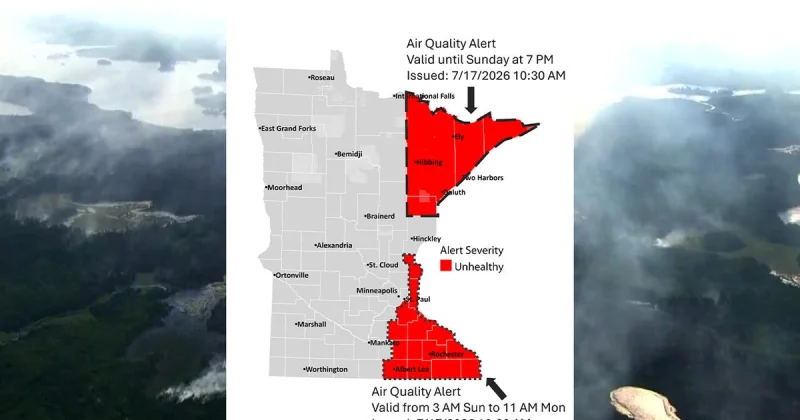
Millions of people across the Great Lakes, Northeast and mid-Atlantic woke up Friday to unhealthy air as wildfire smoke from Canada and Minnesota pushed farther into the U.S., turning Washington, D.C., into a gray, eerie blur. The haze was bad enough to force Major League Baseball’s Cleveland Guardians to postpone their game against the Pittsburgh Pirates in Ohio.
The smoke became the day’s most visible weather story because it reached deep into places that are usually far from the front lines of a wildfire. Communities in Minnesota, Illinois and Michigan, including Detroit, registered some of the worst air quality in the world on Friday, while Washington, D.C., was not far behind Detroit, according to IQAir.
In the capital, the Washington Monument, the Lincoln Memorial and other landmarks sat under an orange-hued haze for much of the day. Stewart Verdery said it was startling to wake up at sunrise and not see the sun even though it was not raining, and said the air smelled like someone was holding the world’s largest cookout. For people trying to go about a normal Friday, that smell was a warning in itself.

Health officials urged people with heart or lung disease, older adults and children to stay inside or cut back on time outdoors until the air improved. Maria Travela said Friday was her first day outside since smoke blanketed the Chicago area early Thursday, and she wore a mask while crossing a bridge over the Chicago River downtown. She said the air had been bad that morning and that people with asthma or other breathing problems were told it could be hard on their lungs.
The relief may not last. Bob Oravec said the smoky conditions would not be gone anytime soon because the fires were still burning largely unchecked, and warnings of dangerous conditions were expected to stay in place through Saturday across a wide swath of the U.S. That leaves the region waiting on weather that can blunt the smoke for a few hours, but not enough to clear it out for good.
Wildfires were burning in Ontario and in the Boundary Waters Canoe Area Wilderness in Minnesota, where U.S. officials closed the wilderness while crews fought the blazes. Premier Doug Ford said there were about 190 wildfires in northern Ontario, and that 10 northern Ontario communities had been evacuated or were being evacuated. Flames destroyed the Namaygoosisagagun First Nation community. Hundreds of wildfires were burning in Canada on Friday, and the rise of fire in vast Canadian forests has largely been blamed on climate change.
President Donald Trump also weighed in Friday, posting on social media that Canada’s forest management was to blame and threatening additional tariffs. But the smoke now spreading through the Great Lakes, Northeast and mid-Atlantic is being driven by fire behavior that is still active, still broad and still unresolved, which means the question for Saturday is not whether the haze was real, but how much of it the weather can actually push away.