


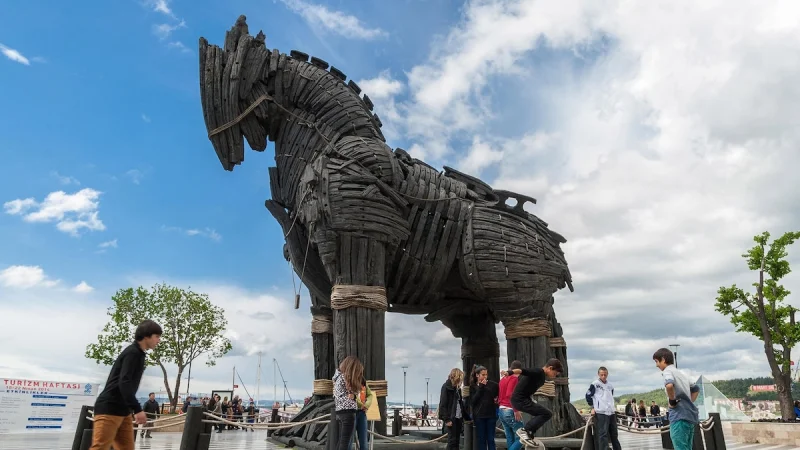
Archaeologists have spent 160 years digging at Hisarlik near Çanakkale, the site widely believed to be Troy, and they still cannot prove it. The main mound is about 90 percent excavated, yet the question that pulls visitors there remains unsettled.
That is why Was The Trojan War Real keeps surfacing now. The site is open, the evidence is visible, and the legend is still powerful enough to draw people who want more than a story from The Iliad and The Odyssey. Rüstem Aslan, who has spent 40 years excavating the UNESCO World Heritage site, says, “Nowhere in the Mediterranean do you have such well-preserved Late Bronze Age ruins, except Santorini, which was covered with ash.”
The reason Troy continues to matter is not that it has one layer, but that it has nine. Archaeologists have numbered the cities that rose and fell there, and Troys 6 and 7 are the ones most often tied to Priam’s Ilium. Over the past 160 years, excavations have uncovered walls, passages, streets, an amphitheater and a destruction layer filled with burned material, skeletons, arrowheads and slingstones. Those remains are part of why many researchers are convinced the site near Türkiye’s northwestern coast fits the story.

Emily Wilson captures the attraction in the landscape itself. She says “it’s still a windy city,” and adds that the flat ground makes it easy to imagine huge armies moving across it. Even with the coastline altered over 2,000 years, she says, a visitor can still look out and sense “here’s this site of this city that was important several times over and destroyed several times over.”
But confidence is not the same as proof. Eric Cline puts it bluntly: “Honestly, there’s nothing that actually says it’s Troy.” He says later Greeks and Romans believed it was and called it New Ilium, or New Troy, and that archaeologists are “pretty confident” largely because there is no better candidate. “Geographically it fits. Archaeologically it fits,” he says, adding that “there’s even destroyed layers that fit the [Trojan War] time period.”
That gap is the heart of the story. The site near Çanakkale looks like Troy, has been treated as Troy for centuries and contains destruction layers that match the right era, but no inscription or clear marker has emerged to settle the matter. Caesar once visited and said, “Every stone has a name,” and that is still the appeal of the place: every wall and burned layer invites a name, but none has yet become a final answer. Until excavation or analysis turns up something more direct, Hisarlik will remain the most convincing Troy we have, and not a proven one.
