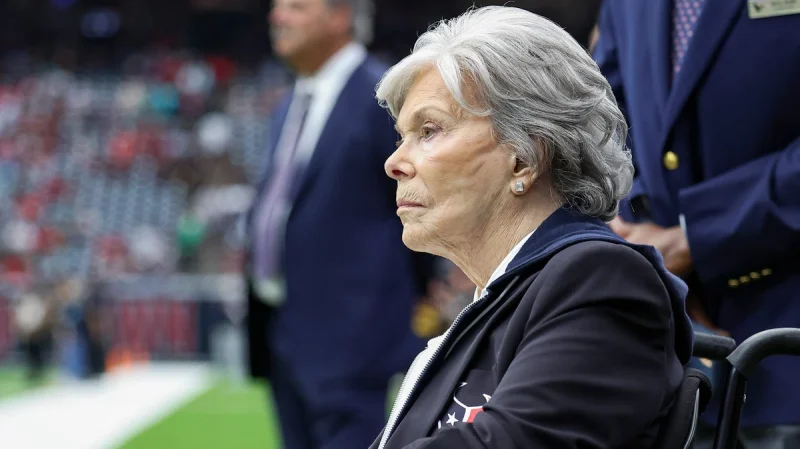
Janice S. McNair, the Houston Texans co-founder and Senior Chair who helped shape the franchise and its public face, died Tuesday afternoon at 89. The Texans said she died peacefully with her family by her side.
Cal McNair said he and his sisters, Ruth and Melissa, felt profound gratitude for having her as their mother. He said she exuded kindness, radiated joy, and lived a life centered on faith, family, philanthropy and football. He added that nothing mattered more to her than her beloved Texans.
Her death lands now because the Texans are saying goodbye to one of the people most tied to their beginning. Janice S. McNair is survived by four children, 16 grandchildren and 13 great grandchildren, and the family’s loss also closes a chapter for a franchise that still traces its identity to the McNairs’ decision to bring football back to Houston.

That story, though, has always been larger than the team itself. Since moving to Houston in 1960, Janice and Bob McNair built a long record of giving, and their charitable work ran through The Robert and Janice McNair Foundation, the Houston Texans Foundation and The Robert and Janice McNair Educational Foundation. Bob and Janice McNair gave more than a half billion dollars to charity, with Janice serving as a director of each foundation.
Much of that giving focused on education and medical research, which gave her public role a different center of gravity than the one fans might have expected from a football co-founder. The Houston Texans Foundation was created in 2002 at the start of the franchise, and since then it has raised more than $51 million. Through The Robert and Janice McNair Foundation, the couple also established McNair Scholars programs that reached the University of South Carolina, Rice University, Baylor College of Medicine, M.D. Anderson Cancer Center, The University of Texas Health Science Center at Houston and Texas Children’s Hospital.
McNair was honored again in 2025 when she became the fourth member of the Texans Ring of Honor, with her name placed in the rafters next to Bob’s and alongside Andre Johnson and J.J. Watt. The team also honored her with a halftime ceremony, a late recognition that fit the way her legacy had been split between football and philanthropy. In the end, her family said, she leaves a mark on the team, the community and the organization itself — and the unanswered question is not what she meant to the Texans, but how much of the franchise’s identity was built in her image.